Monday, December 07, 2015

Myanmar


A mysterious country that has baffled the world

ShareComment
To get such articles in your inbox
Text size:  A   A   A
November 28, 2015 10:07 IST
'Ne Win kept good relations with the Nehru family even though he did nothing to do business with India.'
'When Indira Gandhi was assassinated, Ne Win took off to an undisclosed destination, leading to rumours that he had gone to India.'
'But we had no knowledge of his visit and days later, we were told that he was so struck with grief that he went into meditation on an island.'
Ambassador T P Sreenivasan on mysterious Myanmar.
Myanmar
The designs in a kaleidoscope change at every turn in most unpredictable ways. No design is permanent and no two designs are the same. Such has been the fate of Burma, now known by its ancient name, Myanmar.
Even in the seventy years of independence, the design has changed many times beyond recognition. It is again in a cusp of change, as the world watches with bated breath.
Aung San Su Kyi has already won a convincing victory and she believes that she will lead the country, even if she cannot be president till a constitutional amendment is made. One never knows whether another design will unravel and throw the country into uncertainty again.
If anyone wishes to gaze into the crystal ball and predict the future, there is a pathfinder in the scholarly tome by Rajiv Bhatia, India-Myanmar Relations. Changing Contours (Routledge). After years of living in Myanmar, studying it and researching on it, he has attempted to decipher the several designs in the kaleidoscope.
His travels in Myanmar were not just on planes, but 'in the company of a variety of thinkers, travellers, scholars, authors and leaders, who studied, reflected and wrote about this country.'
No wonder it has twelve pages of bibliography and forty pages of notes, a testimony to the Herculean task he undertook to write the book. The result is an authentic study of a mysterious country, which has baffled the world.
I remember the shock treatment that Burma gave to the Nonaligned Movement in Havana in 1979. Some time in the middle of the night of the general debate, the Burmese foreign minister was invited to speak after a lengthy speech by an African leader.
Normally, the rule in the Movement is that the smaller the country, the longer the speech. Delegates went out for a walk or settled down to a nap, thinking that Burma would have nothing to say.
As the junior most delegate from India, I was glued to the earphone not to miss the Burmese wisdom. What shook up everybody was that the minister finished his speech in precisely three minutes.
When he returned to his seat, everyone in the Indian delegation turned to me to find out what he said. I told them that Burma had just left the Movement as it had ceased to be of any value to Burma. He said that Burma was too nonaligned to be in the Nonaligned Movement!
The Movement took it in its stride and moved on till it came back to a session in Bali asking for re-entry. Under direct instructions from the prime minister, we blocked their return on the ground that the elected leader was denied power.
Burma was, in 1979, in the second of the four phases Bhatia has identified, first, the U Nu era, second, the Ne Win Years, the third, the transition period and the fourth, Than Shwe rule.
Ne Win was in the same class as Pol Pot and Kim Il Sung in that he reduced a fairly prosperous Burma into a bankrupt and isolated country through his Burmese Way to Socialism.
Golf was the only effective diplomatic instrument at that time as the golf course was the only place where we could speak to the Burmese officials. It was a good alibi for me to take lessons in golf, which turned out to be a passion in later years.
Every year, diplomats were invited to the special army golf course, where Ne Win played. The Burmese repeated their golf jokes and laughed loudly on the 19th hole, giving an impression of camaraderie, but without any business being transacted.
'My wife is my handicap!' was the most popular golf joke in Burma!
Ne Win's actions, which led to an exodus of nearly 100,000 people of Indian origin during 1963-1964, are covered in the book. Since then, it was an uneasy calm without substance in India-Burma relations during my time (1983-1986) and all our efforts to give some content was rebuffed.
We imported rice from Burma to please them, the commerce secretary visited Burma, we flooded Rangoon with cultural programmes to which the local Indians and Burmese came in large numbers, but the relations remained static.
The diplomatic community kept itself amused by golf and staging of plays like Charlie's Aunt and The Thwarting of Baron Bolligrew in the British embassy. About forty Burmese families, who were assigned to enjoy diplomatic hospitality, filled our parties to add the local touch.
As Bhatia has noted, Ne Win kept good relations with the Nehru family even though he did nothing to do business with India. When Indira Gandhi was assassinated, Ne Win took off to an undisclosed destination, leading to rumours that he had gone to India. But we had no knowledge of his visit and days later, we were told that he was so struck with grief that he went into meditation on an island.
Then came the indication that he wanted to visit Delhi to express his condolences to Rajiv Gandhi and family. He was very warm and affectionate to Rajiv Gandhi and told him that as his 'uncle,' he would do everything possible to help him and raise the level of India-Burma relations.
On my return after the Ne Win visit to Delhi, I spoke with optimism about a new phase in bilateral relations to the diplomatic corps and the press.
My joy was short lived as the initiatives I took after Ne Win's visit were rebuffed as before. His policy of dealing only with 'third countries' (other than big powers and neighbours) continued with the exception of China, which built up its contacts with generous gifts and the support of the Burmese Communists.
The military dominated kaleidoscope had remained unchanged when I left Burma in 1986 for a more exciting time in Fiji.
I remember discussing Burma with the then prime minister of Fiji, Ratu Mara. He was astonished that the people of Burma had lived under authoritarianism except for a little trouble when the body of U Thant, the secretary-general of the United Nations, was brought to Rangoon.
I thought aloud that it could be because Buddhism might have given the people a sense of resignation to their fate. Ratu Mara suddenly perked up and said to me conspiratorially, 'Why don't you take back all these Hindus from Fiji and send me some Buddhists?' My reaction was a grim smile.
Bhatia is at his best when he describes the state of affairs in Burma, Myanmar now, when he was in Rangoon, now Yangon. The years between 1987 and 1992 have been characterised as transition years, but they were the years of uncertainty, violence and efforts of the army to present acceptable faces after Ne Win resigned.
India was totally opposed to the military government, which forced the military leader to observe, according to Bhatia, that 'India took a very hard line position against the military government, perhaps the hardest line anywhere in the world.'
After the advent of Than Shwe rule, the same P V Narasimha Rao, who blocked Myanmar from re-entering the Nonaligned Movement, decided to start a constructive engagement policy with Yangon.
The author himself steered the new policy as ambassador and the book has the details that no one else could have. The book contains a blow-by-blow account of the events in India-Myanmar relations, leading to a new understanding with the junta, with the reluctant acceptance of Aung San Suu Kyi.
Incidentally, her sojourn in Bhutan had coincided with mine and I did not see any indication of her steely determination at that time.
The complex India-Myanmar-China triangle is adequately covered in the book. Though the general perception is that it is a zero sum game, the author argues that this need not be so.
He is over optimistic about Myanmar seeking diversity in relations by cultivating India and believes that the new Chinese initiatives in the region will reduce the impact of the China factor and provide new opportunities for the three countries. Given the adversarial Chinese position towards India, I would not endorse the author's view.
The state of the remaining people of Indian origin, particularly the farmers, who were requested to stay back when the others left, is a matter of shame.
The author speaks of their warmth towards the Indian ambassador, but not about their grievances. They are virtually State-less and treated as foreigners. They cannot eat even the rice they themselves produce as it is taken away. India generally closes its eyes to the problem to avoid an irritant in bilateral relations.
As was said about Milton's Paradise Lost, Bhatia's scholarly work has to be read as a duty rather than as a pleasure, because the ordinary reader has to steer clear of the mountains of information that come in the way of a smooth passage through the text.
But his admiration for the country is based on his deep understanding of it, which he shares with the readers. When the Myanmar kaleidoscope turns again and a new image appears, we will certainly go back to the book for the insights contained in it to decipher it.
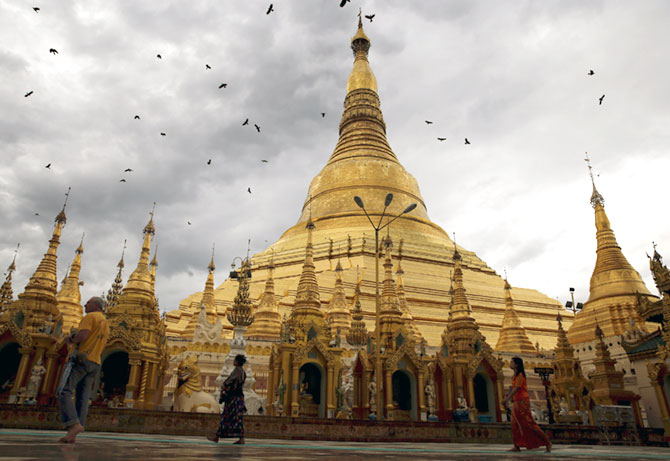
IMAGE: People walk around the Shwedagon Pagoda in Yangon, Myanmar. Photograph: Jorge Silva/Reuters
T P Sreenivasan is a former Ambassador of India and Governor for India at the IAEA; Executive Vice-Chairman, Kerala State Higher Education Council and Director General, Kerala International Centre.
T P Sreenivasan

Wednesday, November 04, 2015

Salesmanship as Statesmanship


Opinion » Lead

Updated: October 28, 2015 22:34 IST

Salesmanship as statesmanship

Comment (47)   ·   print   ·   T  T  
  • A screen displays PM Modi’s speech at Madison Square Garden in New York recently. A close study of the choice of countries Mr. Modi has visited and the speeches he has made would reveal that his strategy is that of a pragmatic businessman who will make deals for his benefit, but the moment the profit dwindles, he will go in search of new clients.
    PTI
    A screen displays PM Modi’s speech at Madison Square Garden in New York recently. A close study of the choice of countries Mr. Modi has visited and the speeches he has made would reveal that his strategy is that of a pragmatic businessman who will make deals for his benefit, but the moment the profit dwindles, he will go in search of new clients.
  • T.P. SREENIVASAN
    T.P. SREENIVASAN

From non-alignment, under which India acted without any specific agenda for itself, we have reached a stage of pragmatic alignment, where we view relationships through the prism of ‘profits’. Can a foreign policy solely based on perceived returns, without a global vision, be beneficial in the long run?

To characterise the foreign policy of the most peripatetic Indian Prime Minister as ‘nationalist’ may appear contradictory. The popular demand today is that he should be in India more often, to deal with the crying needs of the country. He is selective in his eloquence on domestic issues, but he is opening out his heart to foreign audiences. He is seen more in the company of foreign leaders, not only political leaders, but also leaders in technology, finance and economics. But the core of his agenda is domestic, not international. His arena is international, but his concerns are domestic.
The transformation of India’s foreign policy from an ‘internationalist’ one to a ‘nationalist’ one may well have begun after Jawaharlal Nehru and V.K. Krishna Menon. Domestic preoccupations were brought to centre stage, though the old tradition of engagement in world affairs remained alive. The torrent of international issues — such as the conflicts in Indo-China and Korea, the Suez Canal crisis and even the conflict in Austria — in all of which India played a role without any specific agenda for itself, became a trickle.
T. P. Sreenivasan
Perhaps our early day interventions happened because of the activism of the Non-Aligned Movement (NAM), which pronounced itself on every major international issue in its declarations. By shaping those pronouncements, mainly by balancing and moderating them, India found fulfilment in playing its international role. It did not find it necessary to take initiatives to resolve disputes or avert conflicts, except in its own neighbourhood. Our insistence on bilateralism in resolving issues may also have been an inhibiting factor.
From international to regional

In the post-Cold War era, India’s internationalism began to be confined to regional and other groupings, most of them economic. Concerns about the protection of the global commons, such as the environment, assumed importance. We began looking at protecting our own interests, taking positions like ‘no mandatory reduction of green house gases for the developing countries’. We realised that our interests coincided with those of the great powers and the large developing countries like Brazil and even China. Copenhagen was a real turning point in our environment policy when we virtually disowned the Kyoto Protocol except in name. Our nuclear tests in 1998 and the subsequent nuclear deal with the United States left India with no like-minded countries in disarmament. It was the arm-twisting by the U.S. that made the Nuclear Suppliers Group (NSG) provide us an exemption.
UNSC membership

We had earlier used the non-aligned position that only non-permanent membership should be increased until comprehensive reform is accomplished, just to thwart the U.S. sponsored quick fix solution of Germany and Japan being made Permanent Members. However, we then moved on to the G-4 initiative — under which India, Brazil, Japan and Germany would seek permanent membership — which has very few takers among the small developing countries. The G-77 virtually disappeared from many forums because India’s leadership in it withered away.
India continued to take a global view in G-20 and the World Trade Organization (WTO), primarily because of the reputation of Dr. Manmohan Singh as an economic guru, even for Barack Obama. Dr. Manmohan Singh’s withdrawal from the international arena and his close relationship with the U.S. in India’s interests changed the Nehruvian view that India’s dreams coincided with the world’s dreams. During our last term at the U.N. Security Council, India seemed to be in a dilemma as to whether we should work with the nonaligned caucus or plough a lonely furrow; we ended up in flip-flops. Both the Permanent Members and the nonaligned caucus found our term a mixed blessing.
A study of Prime Minister Modi’s visits and speeches reveals that his strategy is that of a businessman, one who makes deals only for benefits. His neighbourhood policy is an example
Mr. Modi’s surprise initiatives in foreign policy from day one seemed to project him as an internationalist. As Raja Mohan summarised in his book Modi’s World, “he warmed up to America, recast the approach to China and Pakistan, sustained the old friendship with Russia, deepened the strategic partnership with Japan and Australia, boosted India’s neighbourhood policy, wooed international business leaders and reconnected with the Indian diaspora.”
We could add to this his championship of the reform of the Security Council; his stress on the environment; and him taking initiatives on getting closer to France, Germany, Canada, the island states and now Africa. But the change is not only in style and eloquence, but in turning Indian foreign policy inward. He has abandoned internationalism, genuine in the case of some of his predecessors and a cloak in the case of some others. In any relationship, the litmus test now is: what India can gain for itself, not what India can contribute to the humanity.
Focusing on national interests in formulating foreign policy is fundamental for all countries. But turning statesmanship to salesmanship is a new phenomenon in Indian foreign policy. Our tradition has been to provide leadership to the world, not to demand it as our right, as Mr. Modi did in the case of the permanent membership of the Security Council. Speaking of our eminent qualifications is one thing, but claiming it as a right may drive our supporters away. Our case was that we were willing to serve on the Council to restore the balance there and to make it more relevant, not to claim membership as a right to protect our interests. Even the Permanent Members never claim that they have a right to be there.
A close study of the choice of countries Mr. Modi has visited and the speeches he has made would reveal that his strategy is that of a pragmatic businessman who will make deals for his benefit, but the moment the profit dwindles, he will go in search of new clients. His neighbourhood policy is a case in point. He started off with the ambition to remove poverty in South Asia through a renewed South Asian Association for Regional Cooperation (SAARC), but soon discovered the perfidy of Pakistan. He persisted for a while as India had much to gain from a transformation in India-Pakistan relations. However, SAARC is no longer a priority in his development agenda. Nepal is another case where his hopes were belied. Remember the cordiality and the oneness he projected with Nepal in the name of the eternal values the two countries shared? However, today, he has virtually imposed an embargo on Nepal for not listening to our advice. Indira Gandhi did the same once, but she had explained repeatedly to the international community the rationale for her actions and had restored normalcy after a while. The world will watch our policies and make conclusions on our reliability and statesmanship.
Misplaced notion of grandeur

The common elements in Mr. Modi’s speeches abroad can be clearly identified. First and foremost, it is the grandeur of India and his own role as its man of destiny. Second, he claims that things have changed dramatically since he took over and that India is now ready to receive investments and recognition as a global player. He feels the world has a stake in India’s development and security and that it is imperative for other countries to work with India.
He does not offer any specific concessions but expects the others to respond to his initiatives for their own benefit. According to him, ‘Make in India’ and ‘Digital India’ are opportunities for the world to promote India and derive benefits for themselves. In other words, the logic is one applied to a honest business in which every partner makes profit.
Statesmanship demands every national leader to have a global vision — he should place his country in the larger context of the well-being of the mankind. In Mr. Modi’s case, India is at the centre of the world. In his speeches at the UN, he claims that what the UN does today was anticipated by India long ago. If India considers the Earth as the mother and calls the whole world a family, it has nothing to learn from sustainable goals, so meticulously put together by other nations.
Mr. Modi raised the reform of the Security Council even in the sustainable development session, without saying what India would do as a Permanent Member for the world. His sticking his neck out on this issue, when there is little hope of progress in the near future, seems ill-informed at best. Similarly, he did not seem to notice that the Presidents of the U.S. and China were grappling with the problems of too much connectivity at the very moment he was selling ‘Digital India’ to the Silicon Valley. Mr. Modi also seems to take the diaspora’s loyalty for granted and expects the Indian community abroad to extend support to him at all times. History has taught us that the diaspora can be critical of India on occasions. The very people who supported the nuclear tests and the nuclear deal were critical when the deal appeared to fall through. Recent events in India have already sparked adverse reactions from them. In Dubai, they were disappointed that their issues were not addressed directly by the Prime Minister.
Whether or not a foreign policy which is premised on seeking advantages for India — without projecting a grand vision for the world —will benefit India, only time will tell. However, for an India that had once taken greater pride in giving to the world than taking from it, Mr. Modi’s foreign policy is strikingly new.
(T.P. Sreenivasan is a former Ambassador of India and a former Permanent Representative at the United Nations)

Still stuck in the old school

Comment (8)   ·   print   ·   T  T  
  • Illustration: Satwik Gade
    The Hindu
    Illustration: Satwik Gade

The New Education Policy won’t work unless a completely new system of education is devised. Only then can India benefit from the demographic dividend of the 21st century

The Secretary General of the Association of Indian Universities, Furqan Qamar, compared the shibboleths in education to the belief in some sects that cats should be present at meditation sessions. It turned out that the practice of keeping cats came into being when a certain guru allowed a cat he was fond of to stay by his side while he meditated, and his followers came to believe that the presence of the feline was mandatory. The practice continued until a guru, allergic to cats, wanted to shoo it away. But the traditionalists insisted that the cat must stay and no one could get rid of it. Mr. Qamar, at a session on “Ranking of Institutions and Accreditation” at the National Assessment and Accreditation Council (NAAC) consultations on the New Education Policy (NEP), expressed the hope that the consultations would lead to the elimination of the many cats which had crept into education.
Successive speakers repeated the cat image but at the end of the day, we found not only that the cats stayed on, but that another litter was on its way. The conservative educationists are extremely reluctant to move away from fixed ideas and practices. As in other established enterprises, innovation is hard in education, since it will affect a whole new generation, and may be expensive and risky. But unless we eschew shibboleths and move with the times, the NEP will be old wine in an old bottle.
Themes and questions

The NEP is meant to replace the Education Policy, which was formulated in 1986 and amended in 1992. Twenty themes have been identified for discussion in higher education: ten of them at the grassroots level and ten at the State level. In addition, major regulatory organisations and voluntary bodies have been asked to hold consultations on some of these themes. But the themes and questions framed do not go beyond the surface in many cases. From Swami Vivekananda to Amritanandamayi, Sarvepalli Radhakrishnan to Sam Pitroda… they all have pronounced on education and nothing more can be said. What we need is a new action plan to devise a new system of education, without which our graduates will not be able to benefit from the demographic dividend of the 21st century.
The Bengaluru meeting dealt with only one theme, Rankings and Accreditation. Things went back to square one after a day of deliberations. A methodology for a ranking framework had already been announced for engineering and management institutions, and the meeting meekly asked for such a framework for other institutions too. The methodology of ranking by foreign agencies, which had reluctantly put a couple of Indian higher education institutions in the list of 200 world-class institutions this year, was criticised, but no formula was found that would help Indian universities become world class. Nobody seemed bothered about the state of affairs, though the lament until recently was that Indian institutions were below 200 in the rankings. Our ranking framework is expected to create an impact internationally.
Status quo in accreditation

Accreditation was another issue on which the meeting decided to stick to the status quo. Everyone agreed that the backlog of unaccredited institutions could not be cleared by the NAAC, and that multiple agencies are needed. But again, there was no inclination to even experiment with State or private agencies. The fear was that such agencies would become partial and corrupt, a charge from which the NAAC itself has not escaped. The recent expansion of NAAC was noted with satisfaction, and it was decided that statistics about unaccredited institutions will be collected.
In Kerala, even reforms that have been accepted in the rest of India are facing adamant opposition. Even after the new autonomous colleges have shown potential, fears and suspicions cloud the horizon. While everyone concedes that private universities will bring in much-needed investment and a new range of universities, scepticism prevails about their misuse even after the draft legislation is riddled with conditionalities.
Most States seem to have completed their grass roots consultations on NEP, and now regional and national consultations are scheduled. But the indications are that much will remain unchanged, unless the government takes bold decisions outside the given themes. Many are stressing secularism, justice and the spirit of enquiry for fear that the purpose of the current exercise may be the saffronisation of education.
The government would do well to pull out some of the bills pending in Parliament such as the final shape of regulatory bodies and the policy on operation of foreign universities in India. Talk of internationalisation sounds hollow without a positive policy on foreign universities. Many universities are said to be waiting in the wings to enter India. Unless a policy is laid down immediately on foreign universities, internationalisation will pass us by.
The Rashtriya Uchchatar Siksha Abhiyan (RUSA), a mission which was announced with fanfare by the previous government to provide massive financing to State universities, appears to be in ruins today. One of the primary purposes of RUSA was to increase the Gross Enrollment Ratio. Innovative proposals, invited on a competitive basis, were discarded in favour of routine infrastructure improvement. The allocation is a case of too little too late. The whole process is still in the grip of the bureaucracy.
The expectations raised by the current national consultations on the NEP will be belied if the shibboleths in the educational system are not discarded. What we need is a revolution, not tinkering with the existing system.
(T.P.Sreenivasan, a former ambassador, is the Executive Vice-Chairman of the Kerala State Higher Education Council

Saturday, October 17, 2015

Archbishop Mar Gregorios Lecture at the Vatican


Memorial Lecture on ‘Archbishop Mar Gregorios: His Vision and Contributions to Social Development and Secularism in India.’ at the Vatican Oct 17, 2015

Your Beatitude Mar George Cardinal Alamchery,
Your Eminence Leonardo Cardinal Sandri, Representative of HH the Pope,
Your Beatitude Mar Baselios Cardinal Cleemis,
Your Excellencies,
Brothers and Sisters,

I am here on a pilgrimage to one of the holiest of holy places, as desired by His Beatitude Baselios Cardinal Cleemis Catholicos. I consider myself doubly blessed that this pilgrimage is to pay a tribute to Archbishop Benedict Mar Gregorios, who touched my life in many different ways. I have been a beneficiary of his vision and his contributions to social development, particularly education, and secularism in India.
 Archbishop Mar Gregorios gave me my first ever employment in the Mar Ivanios College, of which he was the Patron, and gave me my first pay check. It was there that I met my bride and married her with his blessings. When I embarked on my Foreign Service career, he gifted me a fountain pen “to make peace, not war”, which is one of my prized possessions even today. My close association with the Malankara Syrian Catholic Church and the Mar Ivanios Institutions continues till today.
The birth centenary of Archbishop Mar Gregorios has coincided with the period that His Holiness the Pope has dedicated to the great souls of the Catholic Church and it is in this context that we remember him today. This commemoration also coincides with the historic synod at which the church is looking at the kind of issues that Mar Gregorios grappled with in the past. As a worthy successor to Archbishop Mar Ivanios, who led a congregation of Christians to return to the fold of the Catholic Church, Archbishop Mar Gregorios has made a great contribution to the international Catholic Community. But my topic today is not his spiritual attainments, but his vision of a prosperous and secular India and his personal contributions to bring it about. The ultimate objectives of his prayers, love and sacrifice were for the good of the human kind.
Secularism in any individual depends on how strong his faith is in his own religion, because every religion teaches tolerance, brotherhood and love. Fundamentalism and obscurantism drive people away from the roots of their religions and alienate them from the one God that every religion expects us to worship. In the case of Archbishop Mar Gregorios, secularism was fundamental to his faith and commitment to Christianity.
In Kerala, we take pride in the fact that Indians embraced Christianity long before Europe did. We welcomed every civilization and every religion, as we discovered that none of them contradicted the basic concept of “Vasudhaiva Kudumbakam” (The whole world is a family) The Indian way of life, named Hinduism, was enriched rather than diluted by the waves of thoughts that came to our shores.
Archbishop Mar Gregorios belonged to the “Sannyasin” or ascetic order of the Malankara Church, which followed in letter and spirit the words of the Bhagavad Gita, “One who is unattached to the fruits of his work and who works as he is obligated is in the renounced order of life, and he is the true mystic: not he who lights no fire and performs no work.” While many Hindus saw “Sannyas” as the last of the four age based stages of life, namely, Brahmacharya (student) Grihasthasrama (householder), Vanaprastha (retired) and Sannyas (renunciation), the Bedhany Ashram founded by Mar Ivanios went from “Brahmacharya” to “Sannyas” and the Mar Gregorian thought transformed “Sannyas” from a period of introspection and meditation into a period of action in the service of the Lord.
Steeped in the history and culture of India, symbolized in the ochre robe he wore, Mar Gregorios did not consider Christianity to be alien to the land he belonged to. The land where he was born and chose as his sphere of activity shaped his life as much as his Christian thought. Secularism, therefore, was an integral part of the Gregorian way of life. His life was that of a “Karma Yogi” envisaged in the Gita and the Upanishads. More than tolerance of other religions and faiths, he integrated them into his own faith and way of life.
 Even in societies, in which secularism and freedom of expression are guaranteed, it is possible to have frictions arising out of a sense of offence caused by different religious beliefs and practices. On occasions, such a feeling of offence, whether real or imaginary, erupts into conflicts and violence. Mar Gregorios not only condemned such tendencies, but also stepped in to smoothen the feathers in his own inimitable manner and restored peace and harmony. It was not in his nature to tolerate violence and bloodshed. He directly intervened in some of the communal conflicts in and around Trivandrum and succeeded in bringing the communities together again. His secular credentials were such that his opinion was respected by every community. No wonder the former President of India, Mr.K.R.Narayanan, characterized him as the symbol of secularism in India.  
Secularism for him was not just a matter of religion. As the salt of the earth and light of the world, his compassion and love were not confined to any particular section of the people. He believed that, like Jesus Christ, the Buddha, Gandhi and Narayana Guru and many others, his mission was to wipe every tear from every eye. His vision was to eradicate poverty, hunger and disease from the face of the earth, which led to his sustainable development agenda. He used his own hands to plough the land and to sow the seeds. Fifty years ago he spoke and worked like His Holiness Pope Francis does today. He came down to the people, worked with them in every area of development and introduced a new culture of service of the poor as the service of the Lord.
Education was a vocation he loved and embellished. Teaching came natural to him. As a teacher and Principal of Mar Ivanios College, he built a first rate institution which continues to be a model for private public participation. He built several new institutions, beginning with kindergartens to higher education, including technical and vocational programmes. He introduced skills development in education, which has now become a national priority. He saw education as integral to the development of the soul and body and as a resource to find solutions to the problems of the society and to make life meaningful, noble and purposeful. Like Narayana Guru, he gave attention to the head, the heart and the hand in his educational endeavors. He stressed the need for education to change with the times and to use the most modern teaching methodologies and technology. His contribution to liberate education from political interference, corruption and indiscipline is of equal significance.
In my current efforts to reform higher education in Kerala, I am inspired by the Gregorian concept of education as the tool for nation building. The beginnings he made in making education an instrument of social change can be seen in the educational institutions he built. Many years before the IT revolution, he introduced technology-based education. He saw skil development as one of the essential components of education and demonstrated how to build a holistic education system. When the Oommen Chandy Government created autonomous Colleges in Kerala for the first time in history, the  Mar Ivanios College was one of the first to be selected as it met all the criteria stipulated by the University Grants Commission for conferring autonomy. He had introduced many reforms in higher education, which we see today as the integral part of an education for the twenty first century.
As a trained economist, his focus was on planning and development of every sector. He saw the linkage between knowledge and environment when the awareness of the need for environmental protection was non-existent in education. His attention turned to farming, not just as a means of providing livelihood to people, but as restoring ecological balance. His constant quest was for new trees and plants wherever he went and he brought seedlings of rare trees from as far away as the United States and popularized them in the villages of Kerala. In his scheme of sustainable development, education, agriculture, industry and trade were equally important and he considered them as part of his mission in the service of God.
Science was very much a part of religion for the Archbishop. Nature was his laboratory and he brought in the most modern scientific techniques In horticulture, fisheries, sericulture and others. Low cost housing was a passion for him and he discovered the genius of Laurie Baker, who brought in innovative housing, which adorns Kerala today. He inspired a new generation of architects who cared for the environment and maximized the blessings of the Kerala climate in affordable dwelling units.
The industrial units he set up provided jobs for the poor, particularly women and opened new frontiers of production and export. He discovered the potential of the garment industry long before India developed textiles as a major export under the facilities opened up by the World Trade Organisation. Every activity for sustainable and holistic development was part of his development agenda, which enriched the educational, scientific, agricultural, industrial, and commercial fields in Kerala and provided a model to the rest of India.
To encapsulate the multifaceted genius  and the veritable rainbow of activities of Archbishop Mar Gregorios is no easy task. An enlightened spiritual leader, an embodiment of secularism and Indian culture, a practical economist, an outstanding educationist, a modern agriculturist, an innovative entrepreneur, a compassionate healer, an eminent linguist and a perfect human being, he defies all definitions. In my view, he should be remembered as a Karma Yogi, who gave a new meaning to renunciation and priesthood. In his own words, “Priests are not mere worshippers of God. They are committed to convey the grandeur of God to all creations and to bring them closer to the Almighty. A man, who lives a full life in the service of God is a gift from God.”  We should be grateful to God for giving such a gift to us in the person of Archbishop Mar Gregorios, who gave us his love in abundance and enriched our lives. We are fortunate to have seen his life and work. Future generations will scarcely believe that one person has accomplished so much in one lifetime.
Thank you.


G


Sunday, October 11, 2015

Soft Power: India-Gulf Education and Cultural Ties


Soft Power—India-Gulf Educational and Cultural Ties

Mr.Chairman, (Ambassador Talmiz Ahmed),
Chancellor of the University,
Fellow Panelists,
Ladies and Gentlemen,

I thank the leaders of Symbiosis International University for inviting me to this Conference. I suspect that I have been invited because I live in Kerala, the state, which has been touched most by the Gulf, in ancient and in modern times. Since I am in education in Kerala, I linkages with the education scene in the Gulf. Yet another affinity I have is that my younger brother, T.P.Seetharam, is the Indian Ambassador to the UAE. Of course, I must add that what I say will be on my own responsibility and should not be attributed to him.


Months after this Conference was planned, much after I accepted your invitation to make a presentation on the influence of India’s soft power in the Gulf, a game changing visit of Prime Minister Narendra Modi took place to one of the leading countries in the Gulf. It transformed not only India’s relations with the UAE, but also sent waves across the Arab world. It appeared as though the Symbiosis International University had the wisdom and the foresight to anticipate those developments. That is how this Conference has become celebratory, rather than speculative. Today, we can speak with greater confidence about the potential for India-Gulf partnership. We can assert that age-old cultural ties can blossom into mutually beneficial links at critical times.

The very fact that we characterize India-Gulf relations today as “Link West” tells the story of the times. The word, “West” so far meant the lands farther west of West Asia. This is not the first time that we are looking west. The problem was that both India and the Gulf were looking west and, therefore, we hardly saw each other. When we began to see each other, we discovered the immense possibilities of employment for Indians in the Gulf, which transformed the skyline of the entire region. The inclement weather and other hardships did not deter the Indians from making flowers bloom in the desert. The Gulf, in turn, welcomed them with open arms and the wages they earned and their remittances transformed the Indian economy.

Indian cultural contacts date back centuries and continue with intensity today. These will only increase in the future, regardless of the political and economic future of India and the Gulf. For thirty years or more, the skilled and semi skilled Indians served the Gulf countries with devotion. They were able to mix with the local community because of the freedom they enjoyed for cultural exchanges and worship. Indian habits and customs were familiar in these countries because of the interactions of the past. Many Indian workers spoke Arabic even before they went to the Gulf and it was not long after that the Arabs began speaking in Hindi and Malayalam, which their forefathers had brought back from their voyages to the east. Indians in the Gulf invited their employers and friends to India to savor the salubrious weather of the Kerala coast and to rejuvenate them with Ayurvedic treatment. No wonder that these complementarities made the Gulf home to 7 million Indians and remittances exceeded 35 billion dollars a year. I come from Kerala, where no one has remained untouched by the two way Gulf wave.

The seven Emirates that formed the UAE in 1971 have for long had close interaction with the west coast of India with Bombay, Pune, Gujarat, Malabar being main points of interaction. Pearls, dates and salted fish were exported to India and almost all their needs from food items to textiles and furniture coming from India. Sheikh Zayed's palace in Al Ain, now a museum is full of Indian furniture and textiles. Young men would offer "the finest silks of India" when seeking brides. Indian sword was a priced possession. Families were sent to Bombay for holiday and shopping when the menfolk were busy at sea during the pearl diving season. Miraj near Pune was a popular destination for medical care. Wood and coir to make boats and boats themselves came from the Malabar Coast. Indian food, spices and oudh (perfumes) became essential elements of daily life in the Gulf. Indian merchants dominated trade in the gulf, while teachers, doctors, accountants and professionals from India were pioneering service providers as lifestyle changed from that of wandering as Bedouins to a settled urban living.

With television came Bollywood dubbed into Arabic with a large fan following every gossip in the life of actors on and off screen. Urdu, Hindi and Malayalam are spoken specially by those of the older generation. Cricket infrastructure has come up in Sharjah, Dubai and even in Abu Dhabi to attract matches between the teams of the subcontinent. No event attracts more people in these cities than an India-Pakistan cricket match.

Indian associations and community organizations flourish and compete with each other in bringing classical, folk and cinematic events to the Gulf as corporate sponsorship is easy to mobilize. Pandit Jasraj, Hari Prasad Chaurasia, Amjad Ali Khan, Kathakali, Koodiyattam, Kathak, Mammooty, Mohanlal, all attract huge audiences. Abu Dhabi Tourism and Cultural Authority is currently hosting the Indian Symphony Orchestra of Mumbai, Gulzar rendering Rabindra Sangeeth and a reputed Kathak group for a predominantly Emirati audience at ticketed events at the prestigious Emirates Palace. Contemporary Indian artists are featured prominently at art exhibitions. The Abu Dhabi branch of the Louvre has already acquired an antique Nataraja statue from a museum in Australia and a large Indian miniature paintings collection that belonged to James Ivory of the 'Merchant-Ivory' fame. Onam is celebrated on every Friday from August to November in some part or other of the Gulf with more fanfare and colour than in Kerala. 


Several Indian newspapers and journals are printed and distributed in the Gulf and local newspapers have large sections of news from India. In some countries, Indians outnumber the local populations, but they are not disruptive of the political or cultural milieu of those countries. Just as Indian restaurants flourish there, Arab food is much sought after in Kerala today.

As the people to people contacts grew, so did trade relations. GCC is the biggest trading partner of India today and it provides half of India’s oil requirements. For India, Gulf is a bigger market for its goods than the European Union today.

India’s principled support for Palestine was an anchor of India’s relations with the Arab world right from the time of India’s independence. Yasser Arafat was received in India several times as the head of state of Palestine, not just as a freedom fighter. The sentiments of the OIC on Kashmir and the Muslim community in India were tempered by the fact that India stood for justice for the Palestinians throughout. India recognized Palestine as a state far ahead of many others.

Even with all these ingredients, India-Gulf relations did not become a strategic partnership. It had to wait for the right moment when global power shifted from the west to the east, the United States began disengaging from the region because of its rapidly reducing dependence on Gulf oil, the menace of terrorism and piracy demanded cooperation between India and the region and India’s economic growth and keenness to seek investments impressed the Gulf community.

Prime Minister Narendra Modi struck gold in the Gulf during his recent visit to the UAE because of the firm foundations of traditional links and the imperatives of cooperation, which emerged in recent times. He received a warm welcome by the Crown Prince and his brothers at the Abu Dhabi airport, held cordial discussions with them, visited the grand mosque, met Indian workers in a labor camp, received the gift of a plot of land for a Hindu temple in Abu Dhabi and issued a historic Joint Statement with the Crown Prince. In Dubai, a 50,000 strong audience heard an electrifying speech about his accomplishments and future plans. Basking in the glory of a highly successful visit, Prime Minister Modi wondered why no Indian Prime Minister had visited the UAE for 34 years, even though there were 700 flights a week from India to the Gulf. He was implying that the Governments were far behind the people in forging ties in the Gulf.

Modi spoke at length at his Dubai oration on the implications of the new understanding on terrorism, making it clear that the UAE had clearly sided with the Indian view on terrorism as the two had decided to “coordinate efforts to counter radicalization and misuse of religion by groups and countries for inciting hatred, perpetrating and justifying terrorism or pursuing political aims.”  Though he did not mention Pakistan by name, he said that terrorism as an instrument of policy stood condemned. The support to India’s proposed Comprehensive Convention on International Terrorism was also significant, he said. The main reason why the Convention ran into rough weather was the argument by some Islamic countries that freedom fighters should not be deemed terrorists by definition. With the new understanding of terrorism, there would no more be “good Taliban and bad Taliban.” The establishment of a dialogue mechanism between National Security Advisers and security agencies took anti-terrorism to the level of defence cooperation, including regular exercises and training of naval, air, land and Special Forces and in coastal defence. The UAE also announced support for India’s quest for a permanent seat on the UN Security Council.

A ‘Dawn’ editorial remarked that the visit should be nothing less than a wake-up call for Pakistan. Even more significantly, it said, "Lingering territorial disputes are no longer the driving force behind foreign policy. Instead, the foreign interests of states are now, more than ever before, viewed through an economic lens. States can be rivals in one sphere and partners in another.” The Indian initiative was noted with admiration as part of the contemporary trend of playing on different chessboards at the same time.

The editorial called for maturity in Pakistan`s foreign policy and said that "as a thaw with Iran opens up opportunities to the west, and the possibility of building an economic partnership with India to the east -- however remote it might seem at the moment -- remains a viable foreign policy goal. It`s time to emerge from the old world, and recognize the changes happening in our region before it`s too late". The speculation was that India had stepped into the UAE-Pakistan breach caused by Pakistan’s refusal to send troops to the Yemen war. Some observers even complained that the UAE had given a platform in Dubai for anti-Pakistan rhetoric.

Securing a commitment of increased UAE investment in India was a greater challenge. But Prime Minister Modi convinced them that India was emerging as the new frontier of investment opportunities, especially with the new initiatives by the Government to facilitate trade and investment. The UAE readily agreed to make an immediate investment of USD 75 billion and to increase trade by 60%. 

Prime minister Modi’s Arab Odyssey was both a culmination of age-old ties and a beginning of a new era. The ease with which an Islamic country related to a person of Modi’s background and reputation was striking. The UAE rulers seemed to care more about India’s future than about Modi’s past. The success of his visit to the UAE was an instance of brand India having greater appeal than brand Modi.

I dwelt at length on the visit of our Prime Minister to show how the soft power of India played itself out in forging a strategic partnership in the Gulf. The cultural and educational cooperation will also grow in the new dispensation. India already has cultural and educational exchange programmes between India and the Gulf. India is synonymous with education and a large number of Indian schools have multiplied educational opportunities. Indian universities of repute have campuses in the Gulf. Indian cultural centres attract not only the Indian community, but also the local population. The Gulf has discovered the vast technology and knowledge resources of India. Joint research projects have already been launched in several Gulf countries. India’s experience of pluralism despite its diversity and economic problems should provide inspiration to the Gulf, which is struggling with sectarian divisions.

India and the Gulf have rediscovered each other in the new global context. But what gives strength to the new partnership are the civilizational links and cultural affinities. Soft power is at work between India and the Gulf.

Thank you.


Friday, September 11, 2015

Disaster Preparedness and Management


Remarks by former Ambassador T.P.Sreenivasan at the UN Academic Impact Seminar on ‘Disaster Preparedness and Management’ at the UN Headquarters in New York. September 11, 2015.

Chairman Ramu Damodaran,
Panelists and
Participants,

I am delighted to be back at the UN, particularly in Conference Room 6, where I spent many days and nights, working on resolutions, which, we believed, would change the fortunes of the world. Even the room has not changed, except for the multitude of electronic gadgets and audio-visual equipment all around us. As for myself, I have lost touch with the UN jargon and can speak only like an outsider.

As someone, who has moved from diplomacy to higher education, I am fascinated by the work of UN Academic Impact under the leadership of Ramu Damodaran. I am honored to be invited to participate in the seminar to share the experience of a diplomat and an educationist. The more the academic community gets involved with the UN, the better it will be for both.

I have been fortunate enough not to be in the middle of a disaster, though I have faced many official and personal crises. So I cannot claim any direct experience of handling disaster management. But I have a friend in UNEP in Geneva, who has handled so many disasters that he expects to name his autobiography “My Life and Other Disasters.” I have gained some insights from his experience. I shall also share some stray observations on the basis of my experience in the UN.

The UN was created to prevent war, the biggest man made disaster of all. Through preventive diplomacy, peace making, peacekeeping and peace building, the UN has contributed to make the world a peaceful place. The UN principles and practices, such as preparedness, disaster relief and recovery are now being applied to disaster management. In tackling disasters, the UN and its Agencies draw heavily on the experience of the UN in the last 70 years.

While the number and intensity of wars are less today, natural disasters seem to have increased on account of terrorism, global warming, climate change, desertification and other phenomena.  Today, we have scientific evidence to show that many such phenomena are consequences of human activity. There is hope, therefore, that these can be prevented by more responsible human behavior.

Predictability of natural resources has also increased because of research by some of the UN Agencies such as the IAEA and the CTBT Organization. In their search for evidence of nuclear tests, they have come across technology, which can point towards possible earthquakes. People also predict disasters by observing unusual developments around us. Even as we speak, some people in India are saying that a major tsunami or earthquake is likely because it has been observed that fish are jumping out of water to die on land!

Man has lived with natural disasters for centuries and even accepted them as nature’s way of maintaining a balance in human population. India takes pride in the fact that it has made peace with nature and does not worry too much about aberrations in nature. When Dr. Radhakrishnan, the philosopher President of India arrived at the White House lawns by helicopter, the weather was very rough. President Kennedy apologized that the US had not yet mastered the technology of changing the weather. Dr. Radhakrishnan said that he did not have to worry as Indians had mastered the technology of accepting the weather centuries ago.

Today, international cooperation can prevent disasters by setting standards for construction and maintenance, evacuation plans and environmental planning. The UN has played a major role in disaster relief in every major disaster, whether it is Nepal, Haiti or Fukushima. At the same time, in disaster management, the affected country should take the lead and the work of the international community should be supportive. Dispatching a huge number of relief personnel is not always helpful.

The UN should focus on promoting an ecosystem-based approach for reducing disaster risks and climate change adaptation. Any development strategy, which does not take into account disaster risks and environmental damage cannot be sustainable.

Finally, I would stress the need for educating the masses on disaster management. The Kerala State Higher Education Council has been working with UNEP in Geneva in developing a MOOC course, a revolutionary new concept in higher education, to promote awareness of the new knowledge about ecosystems. The course has been planned for both policy makers and experts. 12000 students from 183 countries signed up for the course. The MOOCs model developed by UNEP should be supplemented by the specialized knowledge of other Agencies such as the IAEA and UNIDO. For instance, the investigation on the Fukushima disaster revealed some strange facts. A Japanese Parliament study concluded that the Fukushima disaster was a disaster that could have happened only in Japan. Apparently, the disaster could have been avoided if the younger scientists questioned some of the decisions taken by the management. But the Japanese hierarchy did not permit such questioning. Another fact is that the Japanese society has changed dramatically after the Fukushima disaster. Many young people have chosen to focus on family and children, rather than live alone; having realized that life is fragile and uncertain.

I would suggest that the UN Academic Impact should embrace MOOCS as a matter of faith to lower or eliminate borders to learning.

Thank you.

Sunday, August 02, 2015

A Tale of Two Deals

A tale of two deals

Comment   ·   print   ·   T  T  
“Iran’s new economic freedom and consequential prosperity will propel it to the forefront of the region. It may even become a partner of the U.S. and others in their battle against the Caliphate.” Picture shows U.S. Secretary of State John Kerry (left) speaking with Hossein Fereydoun (centre), the brother of Iranian President Hassan Rouhani, and Iranian Foreign Minister Javad Zarif (right) in Austria.
REUTERS
“Iran’s new economic freedom and consequential prosperity will propel it to the forefront of the region. It may even become a partner of the U.S. and others in their battle against the Caliphate.” Picture shows U.S. Secretary of State John Kerry (left) speaking with Hossein Fereydoun (centre), the brother of Iranian President Hassan Rouhani, and Iranian Foreign Minister Javad Zarif (right) in Austria.

The Iran deal marked a new beginning in Iran-U.S. relations, while the India deal was a culmination of a process of rapprochement

The finalisation of the P-5+1-Iran nuclear deal coincided with the tenth anniversary of the India-U.S. nuclear deal by sheer chance. But the two deals, which came ten years apart, reveal American strategy to deal with nuclear proliferation in two distinct situations and two different times. The U.S. appeared to make concessions in both cases, but the deals served their immediate strategic interests.
The objective was to put the nuclear genie back in the bottle in both cases, though it looked positive in the case of India and negative in the case of Iran. The U.S. was alarmed by the weapon tests of India in 1998 even more than the revelation in 2002 of Iran’s nuclear activities. Imposition of sanctions against India and Iran were swift and severe, once it became clear that India would not sign the Comprehensive Test Ban Treaty (CTBT) and Iran would not abandon enrichment.
Crippling sanctions

The position of strength the U.S. had in both cases derived from the crippling sanctions that India and Iran feared, though in the case of India, the sanctions had disappeared for extraneous reasons even before the negotiations on the deal began. The sanctions were, however, hanging over the head of Jaswant Singh when he negotiated with Strobe Talbott for two years, which actually led to the India-U.S. nuclear deal. Of course, Jaswant Singh pretended that sanctions were not an issue, but Talbott was very specific about the benchmarks to be reached for sanctions to be lifted. Had 26/11 not intervened, sanctions would have been the central issue of the India-U.S. nuclear deal also.
Sitting next to the Iranian Ambassador in the Board of Governors in the early stages of the Iran issue at the IAEA from 2002 to 2004, this writer was aware that Iran’s aspiration was to acquire the status of pre-1998 India. That was the time when India had an ambivalent position on its nuclear capability, with the option of weaponisation. Iran was aware that the major difference between the two countries was that India was not a signatory to the NPT, but expected that it could make up for it by hide-and- seek. Iran expressed readiness to allow inspection of their facilities, but each time the inspectors came back with more questions than answers. The IAEA concluded that there was “something rotten in the state of Denmark” but could not locate the source of the stench.
Iran realized that the game was up when the matter went to the UN Security Council, with the support of India, which was in the middle of the negotiations for its own deal with the United States. Though the Indian vote was in keeping with the position that India had taken since 2002, it was believed that the Indian vote was cast at the instance of the United States. The subsequent massive sanctions and the dire situation of the Iranian economy forced Iran to take the bitter medicine of curtailing its nuclear activities to revitalize its economy.
In the case of India, the negotiations were between two countries, which had a long history of engagement, though occasionally estranged. The George W. Bush Administration was merely taking the “next steps” in a strategic partnership established by the Clinton Administration. In the case of Iran, it was a matter of breaking the ice and proceeding to negotiate a deal, which was hard for a proud nation to swallow. The trust deficit was so great that every detail had to be worked out with sufficient safeguards.
In the case of India, the U.S. was confident enough to accept the reality of its nuclear capability and seek limitations only in the future development of nuclear weapons. In the case of Iran, the effort was to halt and roll back the capability that Iran could acquire.
Liberated

Ten years down the line, the India-U.S. nuclear deal looks like a major concession to India, without any concomitant benefits to the U.S. But at the time of the negotiations, there were multiple levels of political dialogue at the levels of Governments, the U.S. Congress and the members of the Nuclear Suppliers Group, all aimed at tying India in knots. The Hyde Act appeared to circumscribe not only India’s nuclear ambitions, but also its foreign policy itself. But today, India remains unaffected by the political restraints imposed on it. Even after problems arose in nuclear trade between the U.S. and India, there is little acrimony between them on the provisions of the deal. The deal liberated India from the shackles of being a non-signatory of the NPT.
In a sense, the deal has liberated Iran from the threats of war and crippling sanctions, without having to abandon its nuclear programme altogether. It is more transformational to the region and the world than the India deal. Iran’s new economic freedom and consequential prosperity will propel it to the forefront of the region, posing a challenge to Saudi Arabia and others. It may even become a partner of the United States and others in their battle against the Islamic State. The Iran deal marked a new beginning in Iran-U.S. relations, while the India deal was a culmination of a process of rapproachment.
The nuclear opening that India gained by the U.S.-India deal fell short of expectations because of the Civil Nuclear Liability Law and the Fukushima disaster, but it played a role in the emergence of India as an economic power. In the case of Iran, the deal will be more transformational for the country and game changing for the world.
(T.P. Sreenivasan is a former Ambassador of India and Governor for India of the IAEA.)

Tuesday, July 28, 2015

Foreword to 'Shattered Gulf Dream'


Foreword to 'Shattered Gulf Dream'

By T.P.Sreenivasan


Gayathri Devi, a young researcher, has published a study of Benyamin's 'Adujeevitham' with the title 'Shattered Gulf Dream'. I was invited to write a Foreword, which is below.
Foreword

“The creatures outside looked from pig to man, and from man to pig, and from pig to man again; but already it was impossible to say which was which.” These words of George Orwell reverberated in my mind as I finished reading Benyamin’s “Adujeevitham” in Malayalam. Having read this masterly study of the English translation, I realize that several theories can be advanced to place Benyamin and his book in the literary and the socio-political scene. Like other authors of creative fiction, Benyamin may be surprised at the number of theories he has invoked in the fertile minds of others.

The author has rightly analyzed the various strands of the diaspora experience and identified the diasporic trauma as fundamental to Najeeb’s plight, so poignantly portrayed by Benyamin. She comes to the same conclusion as George Orwell that man, in his depravity, becomes one with the animal. Najeeb himself says, “I am a goat.” The English version of the book could well be entitled ‘Goatman’ to convey the message.

In the study of the diaspora, in its various forms and manifestations in different countries and different times, the author places Najeeb as part of the Gulf Diaspora geographically, the Modern Diaspora in time, the Proletarian Diaspora or the Slave Diaspora in nature. Their loyalty to the homeland and their mutual dependence wither away in the case of Najeeb and their social exclusion is irrelevant as he has only goats to interact with socially and even sexually. But he is one with the thousands, who have shattered Gulf dreams to nurse. By a process of “introjection”, the trauma becomes part of their psyche.

Marx’s theory of alienation is also an appropriate theory to invoke in the case of Najeeb. Marx also had claimed that workers are animals. Workers have no stake in the property they look after or the food they produce. The alienation of the diaspora from the society is seen more acutely in diaspora workers. Like men and pigs became interchangeable, the worker and the goats become one in ‘Adujeevitham’.

‘Adujeevitham’ is painful to read, in fact the most painful story I have ever read, because we know it is not fiction. Every Keralite will relate to the Gulf dream, which turned into a nightmare. A shiver goes down the spine to think that anyone of us could be in Najeeb’s shoes or the lack of it, if another option had not knocked on our doors. Those who have been through the kind of experience in the Gulf will probably have worse stories to tell.

I have heard Benyamin say that it was his lonely years in the Gulf that turned him into a writer. Having nothing else to do outside his working hours, he read up everything that he could get hold of for ten years or so and he blossomed into a consummate storyteller. Najeeb’s story came to him as a godsend to put his talents to test. And he came out in flying colours. The present study would enable Benyamin to see new dimensions of his own story and that is where the author of the study has made a great contribution.