Friday, April 18, 2014

Sangam Speech at Sigatoka, Fiji

Friends, 

I was invited to visit Fiji 25 years after I was asked to leave on account of our non-recognition of the military Government of Sitiveni Rabuka. I had a most delightful visit and people at all levels, including Rabuka himself, received me with warmth and affection. Given below are the speaking notes of my Inaugural Address at the 87th Anniversary of the largest Indian organization, the Sangam. It was very well received by the predominantly Fiji-Indian audience.

TPS

Inaugural Address by former Ambassador T.P.Sreenivasan at the 87th Then India Sanmarga Ikya Sangam Convention, Sigatoka, Fiji on April 18, 2014

National President Sada Sivan Naicker,
Convention Chairman Vijay Narayan,
Secretary General Damend Gounder
Past National President Y.P.Reddy,
Justice Jai Ram Reddy,
Brothers and Sisters of the Sangam,
Friends,

The first tweet I posted on arrival in Fiji to attend the Sangam Convention was: “Many things have changed in Fiji in the last 25 years, but the infinite beauty of the blue lagoons, the breathtaking serenity of the Fiji sky and the warm hospitality of the people of Fiji have not changed.” I readily accepted the invitation to revisit Fiji, as I knew those will not change and I have been enjoying all of them in the last few days. I am overwhelmed by your affection and regard for an Indian High Commissioner, who worked here a quarter of a century ago. 

I had said when I left in 1969 twenty-four hours ahead of the time given to me to leave, that I would return one day to spend a day here, but I have been fortunate to spend a whole week. I am grateful to the Sangam, the Indian High Commissioner Vinod Kumar and the Government of Fiji for making it possible. I would like to thank by name three of those who made my visit possible and pleasurable---Past President Y.P.Reddy, Secretary General Damend Gounder and Volunteer Pradeep Singh.

“Effective leadership through spirituality and faith” is not just the theme of the Convention this year, but the very essence of the vision of the founder of the Sangam, Sadhu Kuppuswami. The Indian immigrants, who came to these islands in search of the Promised Land, had nothing with them except spirituality and faith. The only prize possession they brought with them was the Ramayana, the story of the ultimate triumph of spirituality and faith. Rama led his subjects through spiritual values such as filial loyalty, duty, honesty, perseverance, valor and compassion and faith in God and the purpose of his own incarnation. No adversity, including exile in the wilderness, pangs of separation from loved ones, extreme dangers and war, could shake him and his eventual triumph was the triumph of spirituality and faith. No other path is possible for a people, who hold the holy book close to their hearts and work tirelessly.

What the Sangam leadership has achieved since 1926 is the strengthening of spirituality and faith through religious practices, education, healthcare and social and cultural development. The building of Fiji as their own homeland and the loyalty and support that they gave to the other communities was the ultimate demonstration of spirituality and faith. India is proud of their children in Fiji, as they have remained faithful to the culture and civilization of the motherland.

I am not an official representative of the Government of India anymore, but having been an envoy of India to several countries, I can assure you that India is alive to the welfare and interests, not only of the people of Indian origin, but also of all communities with whom they live, because peace and prosperity are indivisible. India and the overseas Indians had rediscovered each other under Prime Minister Rajiv Gandhi, who had begun to see persons of Indian origin as a source of strength for India, but the position India had taken at the time of the coup of 1987 and later was guided only by the vision of "Fiji as the world should be", a multiracial, multicultural state, free of all kinds of discrimination. The 1970 constitution itself was a social compact, encouraged by India, to maintain racial harmony and equal opportunity.

I would like to look forward rather than grieve over the past, but we should not forget that the breach of that constitution and the turmoil in Paradise resulted in the grievous loss of valuable time and resources. I am glad to see after I have talked to leaders of various communities and interests in the last few days that there is genuine regret over those developments and Fiji is well on its way to securing the goals of democracy and equality.

The elections under the new constitution in September will be a real test whether the citizens of Fiji will rise above narrow considerations of race, religion and origin and act in the best interests of the Fiji of our dreams. Fiji will be called upon to establish, as Abraham Lincoln said, “this nation, under God, shall have a new birth of freedom---and that government of the people, by the people, for the people shall not perish from the earth.” India will, like the rest of the world, look forward to the verdict of the people, not because we have any prescriptions for Fiji, but because we want peace and prosperity of Fiji, in which India has an abiding interest.

I am glad to see that even after a long gap, India and Fiji have developed a robust relationship once again. We have earnestly worked with the present Government in its efforts for nation building as well as to hold elections. I understand that India is committed to share its resources and rich experience in holding free and fair elections in Fiji. I also notice that the relations between India and Fiji have become robust and mutually beneficial.

My meetings here with a broad range of opinion makers in Fiji, including Justice Jai Ram Reddy, whom I consider the Gandhi of modern Fiji, the Attorney General and the Minister of Health in the present Government, the Permanent Secretary for Foreign Affairs, Sitiveni Rabuka, who played golf with me before his coup and leaders of various communities and others have convinced me that they do not live in the past. Antagonisms of the past are giving way to a new realization that the future lies in reconciliation and harmony, not recrimination and acrimony.

I cannot wait for another twenty-five years for my next visit to see a resurgent Fiji, nor can Fiji wait much longer before it steps into the wide world to become part of the new architecture of a globalized world. Countries, big or small, cannot escape the effects of globalization even if they want to. The opportunities and challenges of globalization must be met. The power centre of the world is shifting from the Atlantic to the Pacific and every nation in the Pacific has to play a role in the emerging power structure. There has been a rebalancing of the US forces in the Pacific and one can even see the emergence of a new cold war there. Democracy is breaking out everywhere, as was seen during the Arab Spring.

For Fiji, building democracy is only the first step. Development is also essential, not only in terms of GDP, but also in terms of Gross National Happiness that Fiji enjoyed for a long time. The technological revolution is bewildering because it came without a user’s manual. New frontiers of knowledge are emerging everywhere. We cannot anticipate what technological tools will be in the hands of people in two or three years. Future wars may be fought with cell phones and tablets rather than guns and bombs. China has already stepped on to the revolutionary world of 3-D printing.  Fiji must be part of the technological revolution without losing its identity. Fiji has been adding sugar to the world, but it must invent new ingredients of technology to sweeten the globe. Fiji must benefit from the demographic dividend by educating the young people to shoulder global responsibilities. Fiji does not have the enormous problems that face other countries such as pressure of population, urbanization issues and environmental degradation. You still have fresh air, the legendary Fiji water, relished around the globe, and the blue seas around you. Modernization of Fiji is achievable with united action.

You must usher in a Fiji, where, as poet Rabindranath Tagore said, “ the mind is without fear and the head is held high,--- where the clear stream of reason has not lost its way into the dreary desert sand of dead habit.” Together with Tagore, let us pray, in conclusion, “Into that heaven of freedom, my Father’, let my country awake."

Thank you.


Wednesday, April 16, 2014

Fiji Blog 2 April 16, 2014


FIJI BLOG 2

My second day in Fiji began with an interview with Jyothi Pratibha Devi of the ‘Fiji Sun’, a leading Fiji newspaper next only to ‘Fiji Times’. A graduate of the Hindu College in Delhi, Jyothi appeared well aware of Fiji-India relations and the events of 1987 to 1989, though she was only two years old at that time.

Jyothi asked me questions about the circumstances of my departure and how I felt then and how I felt now on my arrival here. The basic point I made was that I left essentially because of a technical reason. It was untenable for a High Commissioner to continue when his country did not recognize the Government of the host country. What was surprising was that I was able to stay for two years in that dubious situation. This was possible because of the mutuality of interests of Fiji and India to remain engaged, given India’s interest in the people of Indian origin here. When I was invited to leave, it came as no surprise.

About the changes in the last 25 years, I said that things were moving in the right direction and the elections in September this year might usher in a new era of multiculturalism and Fiji would once again be “the world as it should be.” On Indian assistance to Fiji, I said that India would respond to Fiji’s needs to the extent possible, within its own capabilities. The relationship, I said, was robust. India had always desired peace and prosperity for all the people of Fiji.

Asked whether I would come again, I said that I wished the distance was shorter and the airfares were cheaper. There was no other constraint about visiting Fiji.

Pradeep and Damend accompanied me to Suva on the old picturesque Queen Road, spotted with resorts of various kinds on the seaside. Many more resorts have come up, but no tall buildings have been built. We stopped for a pizza at the Warwick Resort, which was the Hyatt Regency Resort 25 years ago.

I could hardly recognize Suva, the capital, when I drove in. The skyline has changed with the construction of many tall buildings. YP Reddy’s Tanoa Plaza stands at the centre of the city and I could see the port once again as we could see it from the top of the India House.

The Fiji Times correspondent was waiting for me when we arrived at the hotel. The interview was on the same lines as the Sun interview. The only added question he asked was whether I would like to meet the coup leader of 1987, Sitiveni Rabuka. I said I had nothing against meeting him, as I had no ill will. India’s wish was only to see Fiji flourish as a multicultural nation with equal rights for all its citizens, I said.

A nostalgic visit to the India House in Suva, which was our home for more than three years, took place today. The India House is the same as before, except that it has been remodeled. The children of the High Commissioner are using the tennis court I built as a basketball court for the present. Several old friends, the two Indian Ministers in the Cabinet and the Foreign Secretary attended the dinner by the High Commissioner. The conversation was essentially about the forthcoming elections and the future of Fiji.

Sitiveni Rabuka, the coup leader of 1987 invited me to play golf with him tomorrow. I accepted, but we could not find a mutually convenient time. He might drop by for coffee, he said. The press here is much excited by our meeting after 25 years, but the ice is broken since both of us agreed to meet.

Tuesday, April 15, 2014

Fiji Blog


FIJI BLOG 1

When the dusky Melanesian airhostess of Fiji Air with a flower in her kinki hair greeted me with a “Bula Vinaka”, as I entered the gleaming Airbus from Hong Kong to Nadi (pronounced “nandi”), I realized that my encounter with Fiji after a gap of 25 years had begun. The international airline of Fiji is no more Air Pacific and the Boeing 747, which used to fly between Sydney and Nadi has been discarded. The Fiji experience began right in Hong Kong in the new Airbus with its Fijian interior and legendary hospitality. The full flight, with Chinese, Fijian and Indian passengers arrived smoothly in Nadi right on time after a ten-hour flight. The morning here felt like the middle of the night for me because of the time dfference.

Nadi international airport, which used to look like a minor railway station in India in my time, is a truly modern facility today. Pradeep Singh, the last Fiji Indian to see me off in 1989, (He accompanied me to Sydney on my flight out) was the first to receive me today, together with Damen Gownder,  one of my hosts. We drove to the Tanoa International Hotel of Y.P.Reddy (Travelodge during my time) where the Reddy children, Kamini, Kalpana and Rohit met me over coffee. Pradeep drove me to neighboring Lautoka, golfer Vijay Singh’s hometown, where Reddy has the Waterfront Hotel, one of my favourite haunts in the late eighties. YP received me at his hotel, where my stay has been arranged for tonight.

Looking around in the Nadi-Lautoka area, one can see greater prosperity and growth. More buildings have come up, but the skyline has not changed and there is plenty of greenery around and the blue sea, stretching endlessly. I am told that the Indian community has dwindled to about 30% of the population, but those who have remained are happier and wealthier. One consequence of the exodus of the Indians is that the sugar cane production has become less than half. The British had brought Indians here more than a hundred and fifty years ago as the Fijians could not manage the sugar cane plantations. There will be elections under the new constitution in September this year, first time on a common roll, without racial quotas.

My walk on the waterfront took longer than expected as I walked away from the hotel rather than towards it. The midtown Loutoka appeared unchanged with more Indian shops than before. I passed by the Sikh Temple, where I made a speech in 1989, which led to my departure from Fiji. I thought that I made an unprovocative speech, but it was considered incendiary by the military Government in the situation at that time. The Sikh Temple has been rebuilt with spontaneous contributions from the Sikhs around the world.

A dinner hosted by Y.P.Reddy tonight had many leaders from the Indian community, with whom I had worked, notably Jairam Reddy, known as the Gandhi of Fiji. We reminisced over the events of 25 years ago and hoped that things would be better for Fiji after the elections.

Fiji looks absolutely peaceful and it is difficult to imagine that such a pleasant country could have so many political and social problems.

Shashi Tharoor 2.0


Arithmetic of caste politics will determine Tharoor's fate

Text size:  A   A   A
April 11, 2014 10:25 IST
Shashi Tharoor on the campaign trail'If the Nairs split between Shashi Tharoor and the BJP candidate, O Rajagopal and the Nadars combine with the Leftists and the Christians to vote for the CPI candidate, Bennet Abraham, what would happen to Tharoor.
'It is presumed that the voters do not cast their votes, they vote their castes,' says Ambassador T P Sreenivasan.
I recall a day like this five years ago, the morning after voting closed in the Thiruvananthapuram constituency in Kerala. Victory was in the air and there was a sense of a mission accomplished in the campaign team of Shashi Tharoor, which comprised not only Congress leaders, but also non-political enthusiasts from diverse backgrounds, writers, intellectuals, artists and non-resident Indians.
We were lured by Tharoor's personality and the hope and promise he held out. He looked like a messiah of change, totally different from the other candidates, the harbinger of a new breed of politicians.
The results of the election, not expected for a month, were a foregone conclusion. Words of a majority of a lakh of votes were on many lips. A Minister of State for External Affairs was virtually born.
Today, I can only guess the mood in the Tharoor campaign team, having had to keep away from it as a public servant. The mood may well be optimistic, but no one is willing to predict the results, which are expected on May 16.
The fortunes, not only of Tharoor, but also the national coalition of which he is a part, hangs in the balance. Analysts are not banking on his charisma, but on the arithmetic of caste politics.
If the Nairs split between Tharoor and the BJP candidate, O Rajagopal and the Nadars combine with the Leftists and the Christians to vote for the CPI candidate, Bennet Abraham, what would happen to Tharoor, they ask.
It is presumed that the voters do not cast their votes, they vote their castes.
I have been looking eagerly at all the pictures of the Tharoor campaign to see a familiar face from the campaign team of 2009. Except for a couple of Congress men, who were assigned to the team and a faithful relative, I saw none of the eager supporters of five years ago.
I did not hear of young Indians swarming in as far from the US, the UAE and Sierra Leone to lend a helping hand. They may have been there, but none was visible.
Perhaps, many of them had valid reasons, like mine, to keep away. Others may have felt that Tharoor had enough support within the party and outside, judging from the confidence that he himself and many others exuded. At least some of them were, I am afraid, disillusioned.
Last time, the criticism was on Tharoor's background, ideology and lack of familiarity with his constituency. But the natural adoration of Keralites for those who have succeeded abroad made up for all the doubts, including his alleged closeness to the US and Israel.
It was easy for us to point out that the US had vetoed him even after he had won the second largest number of votes in the election for the post of United Nations secretary-general. It was easy to put up posters of Tharoor with Yasser Arafat to show his love for Palestine.
His half-baked Malayalam had its own charm. In Kerala, speaking 'Manglish' was often seen as a virtue, it being a sign of foreign education and aristocratic life abroad.
Voters presumed that, with his background of the UN, he would leverage UN funds for the development of Thiruvananthapuram. They thought that foreign investors would line up to get here. Cities like Barcelona would be twinned with Thiruvananthapuram, opening the doors to prosperity.
Jumping on the Tharoor bandwagon was the fashionable thing to do.
This time, Tharoor was still the handsomest Nair, as Paul Zachariah put it, and his silver tongue and golden pen were much in evidence, but he appeared bruised and vulnerable in several ways.
Holy cows and cattle class still chased him and all his efforts to demonstrate his love for the game of cricket reminded the people about the IPL fiasco. The tragic death of his wife, Sunanda Pushakar, cast a shadow around him despite his protestation that he should be allowed to grieve in private.
Even my repeated assertions that I knew that Sunanda Pushkar was seriously ill and that I knew someone, who died of the same disease, carried no conviction and dismissed as the desperate efforts of a friend to help him.
The stern conduct rules of the election deterred his detractors from repeating the unanswered questions, but whispers were centered around the events at the Leela hotel in Delhi on January 17 this year.
The main plank of the Tharoor campaign this time was development, the theme of every party and every candidate. The national programmes of the UPA government were mentioned occasionally, but the focus was on the development the MP brought to Thiruvananthapuram by way of new trains, new escalators, new mast lights and big national flags.
The maximum and effective use of the MP Fund, an obligation, was projected as a great accomplishment. The expectation of building the Vizhinjam port and the hope for the establishment of a high court bench in Thiruvananthapuram, Tharoor said, were issues older than him, but he had moved them forward by his continuous efforts. The Opposition dismissed them as flights of fancy and claimed the credit of development for themselves.
The campaign team pointed out how Tharoor had published periodic reports, highlighting his work in the constituency. His use of the social media and interaction with youngsters were effective tools. Though nobody mentioned it, the publication of Pax Indica and a book incorporating the views of the young MPs of the Indian Parliament (India -- the Future is Now) were feathers in his cap. His Malayalam had improved so much that he was brave enough to interpret Rahul Gandhi's speech from English to the vernacular at a public function.
The opposition to Tharoor was formidable this time. The BJP leader, O Rajagopal, the only candidate, who had seen a thousand moons, had a credible record of selfless service and of having done something concrete for the state when he was a minister in the NDA government. He has acquired a saintly image over the years, with no reason for anyone to vote against him. The general belief that he would be a minister in the Modi Cabinet gave him an advantage.
The Leftist candidate from the Nadar community, hardly a Communist, who contested on the CPI ticket, turned out to be a serious challenger as a community leader and social worker. The Aam Aadmi Party's Ajit Joy might also have taken away some votes from the Tharoor vote bank.
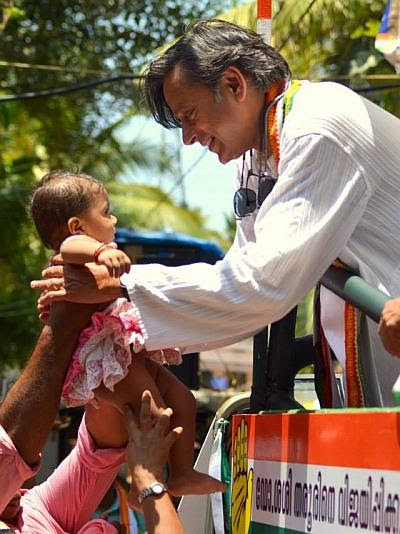
Tharoor is a familiar face and his cultivated costume with a tricolor shawl on his kurta has become a fashion symbol, which was emulated by others at least occasionally. But his campaign clothes this time marked him out as an outsider. The last time, he had sported the local Congress uniform of white dhoti and shirt, which enabled him to merge with Congress leaders.
As Dr Babu Paul observed in his preface to my book, Mattering to India -- The Shashi Tharoor Campaign (Pearson 2011), to be returned from the same constituency again would always, and for anyone, be more difficult than winning the first election.
I shall not hazard a prediction, but express the hope that my friend of more than twenty years will emerge victorious again.
T P Sreenivasan, (Indian Foreign Service 1967), former Ambassador of India and Governor for India of the IAEA, is now the Executive Vice-Chairman, Kerala State Higher Education Council, and Director General, Kerala International Centre.
For more columns by Ambassador T P Sreenivasan, please click here.
T P Sreenivasan

Sunday, March 16, 2014

My presentation at a Seminar at the Kerala Club


Friends,

The Kerala Club, New Delhi organized a seminar on “Planning Higher education in Kerala 2014-2020: Challenges and Possibilities” as part of their celebrations of  the 75th Anniversary on March 16, 2014. The speakers included Shri. T.K.A. Nair, Adviser to the PM, Prof. N.R.Madhava Menon, Prof. V.N.Rajasekharan Pillai, Prof. Jayakrishnan and Prof. Meenakshi Gopinath.

The other speakers described the higher education scene in Kerala graphically and suggested remedies and I tried to showcase the efforts being made by the Government and the KSHEC to bring about change. My speaking notes are circulated herewith for your information and comments.

Sincerely,
TPS

Mr. Chairman,
The President and other leaders of the Kerala Club,
Mr.T.K.A.Nair,
Prof. N.R.Madhava Menon,
Distinguished speakers and participants,

I am grateful to the Kerala Club for inviting me to this timely Seminar on Higher Education in Kerala. I have happy memories of my days in the Kerala Club in Connaught Place in the late sixties when I met people like O.V.Vijayan, Kakkanadan, IKKM, M.P.Narayana Pillai and Sethu, who later became celebrated masters of the Delhi genre of Malayalam literature. Omchery was already a big name then and I am glad that he continues to lead the Kerala Club today. I extend my greetings and best wishes to the Kerala Club on the occasion of its Platinum Jubilee Celebrations.

I am glad that my turn to speak has come in the second half of the Seminar as it gave me an opportunity to reflect over the presentations of the earlier speakers. What occurred to me when I heard those statements was the saying about India that whatever you say about India, its opposite is also true. The same is the case with higher education in Kerala. Prof. N.R.Madhava Menon’s contention that we need more universities in Kerala and Shri.T.K.A. Nair’s apprehension that more institutions are not the answer are both valid. Whether we go by the cynical comments of Dr.Jayakrishnan or the optimistic and poetic assessment of Prof. Meenakshi Gopinath, the higher education scene in Kerala has both good and bad points. It is true that many of our graduates are weak, compared to those from the better universities outside the state. But it is also true that three of our graduates occupied the three top positions in the Civil Services examination last year. Our accomplishments in higher education are not insignificant, but we need to strive more for excellence.

I take it that I have been included in this session on financing development of higher education since RUSA envisages that the Higher Education Councils will be entrusted with funding of higher education in the future, together with planning and monitoring responsibilities. But as it happens, funding of education is one area in which I have gained no experience in the last two years that I have been the Vice-Chairman of the Council. It is only a few days ago that the Government authorized us to open a joint account with the Government to receive RUSA funds and to begin setting up a Technical Support Group. Although the Chief Minister of Kerala is of the view that RUSA should be implemented strictly as envisaged by the MHRD, the process of empowering the Council to implement RUSA has been painfully slow and I have no hands-on experience to share as yet.

Although RUSA marks a paradigm shift in funding state educational institutions, I anticipate some problems in its implementation. Higher Education Councils have not been recognized as bodies capable of planning, funding and monitoring higher education, even in states like Kerala, which has had an active Council since 2007. At best, the Council is treated as a think tank or a sounding board and at worst as a sinecure for sectarian political nominees. The relevant departments of the Government and the Planning Board call the shots and universities and colleges regard the Council as an unnecessary distraction, except as a source of scholarships and minor contributions for seminars and the erudite programme. The philosophy of RUSA that higher education should be entrusted to an academic body like the Council cannot be accomplished without political will and relaxation of bureaucratic controls.

The problem is compounded by the fact that the states have to find 35% of the RUSA resources. The state machinery will be wary of the Council drawing up ambitious programmes as every rupee that is spent on RUSA, 35 paise should come from the state treasury. Moreover, the aided colleges, which make the bulk of the educational institutions in Kerala, will have to find 50% of the allocations made to them by RUSA. The present system of haphazard funding from multiple sources with little accountability will be preferable from the point of view of individual institutions. I have inaugurated many “national” and “international” seminars on esoteric subjects, held simply because a grant was received from one source or another. They become “national” with an odd participant from Chennai and they become “international” by the participation of a Sri Lankan scholar. Money is spent on ceremonies, flowers wrapped in plastic sheets and wooden or plastic souvenirs and even flex boards. The strict performance criteria of RUSA will be a disincentive to many institutions. A complete transformation of the mindset will be imperative. And mindsets, as you know, are not easily susceptible to change.

We can curse the darkness in many ways, but the efforts to light a candle to remove the darkness should also be noted. We have not removed the darkness as yet, but the Government of Kerala and the Kerala State Higher Education Council have not been idle. We started working from day one on a blue print for designing what we called a “Higher Education 2.0”, bearing in mind that fundamental changes are necessary in six areas we identified as crucial--- infrastructure, use of technology, teachers training, research, autonomy and internationalization. We set up groups of eminent experts on each of these areas and developed plans, which were submitted to the Government. These were not mere recommendations, but schemes ready for implementation. A Kerala State Accreditation and Assessment Council, a first of its kind in India, a Faculty Training Academy, a plan to link universities with industries, a new higher education policy with concrete suggestions for enhancing expansion, equity, excellence and employability, a plan for autonomous colleges and a scheme to improve the working of the administrative staff have been submitted. Initial funding was allocated in certain cases, but they are stuck somewhere in the labyrinths of political and bureaucratic decision making. A report on reform of statutes of universities is unfortunately mired in a controversy on the qualifications of Vice-Chancellors.

Concretely, we have made advances in attracting foreign students to Kerala, developing cluster colleges, creating awareness of MOOCS and Flip Schools, TED talks and other tools for using technology, recommended honours courses in selected subjects and we have been running training programmes for young teachers and administrative staff. Seminars and conferences, including two international consultations on quality and transnational education have been held. Our monthly lectures focus on a wide variety of topics of current interest. Sage has just published the first issue of a high quality academic journal, ‘Education for the Future’. We are presently studying issues relating to Arabic studies, foreign travel of teachers and possibility of setting up a University for Police Studies and Forensic Sciences. An area of concern we need to address urgently is the creeping elimination of English as the medium of instruction at the university level. A conference of foreign students in Kerala brought out the fact that much of the instruction is given in Malayalam, leaving these students in the lurch. In a situation where most of our young people have to live outside the state, the neglect of English will severely damage their prospects for employment. The Council is also looking at ways and means of incentivizing teachers, who put in their best.

The Higher education Department runs its own imaginative schemes for skills development, teachers training etc, in addition to their traditional role in nurturing higher education.

In other words, though we have not been able to submit our perspective plan because of the problems enumerated earlier, I dare say that we are more prepared to utilize RUSA funds than any other state in the country. But from a point of elation about the recognition of our work we received initially, we have entered a phase of frustration on account of delays and hurdles. We see a ray of hope in the small beginning we have made in implementing RUSA, but much more needs to be done to make the Higher Education Council an instrument of change.

Apart from RUSA, financing of higher education has to come from private sources. The self-financing colleges were instrumental in increasing the number of engineering colleges in Kerala. Some of these colleges can match the best institutions in India in terms of quality. A Commission led by Mr. Narayana Murthy has established that at least half of the outlay in education should come from private sources. We have identified the ways and means to accomplish this, but the most effective way for higher education to grow is by having private universities. The policy of the Government, however, continues to be not to permit private universities in Kerala.

I apologize if my presentation sounded like a commercial for the Higher Education Council. I was merely trying to show that we are striving to change the higher education scene in Kerala. Change will be slow in coming in Kerala because of the cynicism that has crept into the Kerala psyche. Corruption, mediocrity, sectarianism, lethargy and lack of efficiency are not just tolerated, but also considered part of our system. Higher education sector is no exception to this general environment. But dream we must of good infrastructure, efficient use of technology, committed teachers, purposeful research, increased autonomy and international linkages, in short, world class education. We hope and expect that the Higher Education Council, which is presently a dream factory at best, will turn into a dynamo for true reform in higher education in Kerala.

Thank you.

Wednesday, March 12, 2014

Jagat Mehta: A Diplomat Ahead of his Times


A diplomat ahead of his times

Comment   Share     Text size:  A   A   A
Last updated on: March 10, 2014 16:04 IST
A Tryst Betrayed'His negotiations with Idi Amin and his men for compensation for the Indians, who left Uganda, were particularly tough. Apparently, Amin warned him that the body of the British negotiator, who came earlier, was found in a roadside gutter...'
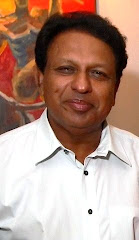
'As Jagat Mehta''s special assistant during the last two years of his tenure as foreign secretary, I saw for myself how his conviction, courage and patriotism enabled him to fight against heavy odds,' says Ambassador T P Sreenivasan.
Former Foreign Secretary Jagat Singh Mehta, 92, who breathed his last this week in Udaipur, had a meteoric rise in the Foreign Service because of his intellectual prowess and strategic thinking. But he proved too much ahead of his times to complete his tenure at the helm of the service.
'Much maligned', 'much misunderstood' and 'more sinned against than sinning' are some apt descriptions of Jagat Mehta.
For a diplomat and statesman, who made an immense contribution to foreign policy right from the time of Pandit Nehru in 1947 to Charan Singh in 1979 in various capacities in the service and later as a thinker and writer, the entry on him in Wikipedia is a meagre paragraph, which does no justice to his illustrious career.
He is described as an Indian 'politician and diplomat' who was Foreign Secretary from 1976 to 1979. His postings to China as charge d'affaires (1963 to 1966) and Tanzania as high commissioner (1970 to 1974), his books and Padma Bhushan award (2002) are mentioned.
"I am not an exportable commodity," Jagat Mehta used to quip when asked about his only ambassadorial assignment to Tanzania. The fact is that he had made himself indispensable in the ministry as a foreign policy thinker and negotiator.
He used to recall how he was the only under secretary in the ministry of external affairs, reported to Pandit Nehru and stayed in the same house he occupied later as the foreign secretary.
He turned his innocuous posting to Tanzania into a major listening post in Africa and won the hearts of the Africans and the Indians in East Africa. Policy makers should reread one of his dispatches on the creeping Chinese influence in Africa to understand Chinese methods today.
It seems the Tanzanians realised the size of the Chinese hordes, which had arrived only when they saw the quantity of noodles being imported into the country.
Jagat Mehta returned to the ministry as joint secretary and was soon appointed by Indira Gandhi as foreign secretary, overlooking the claims of some of his seniors. He was considered Indira's blue-eyed boy during her term, even through the first nuclear tests, the emergency and her defeat in the elections in 1977.
The change of government gave Mehta an opportunity to shape the Janata Party's foreign policy through 'genuine nonalignment'. Morarji Desai and Atal Bihari Vajpayee were inclined to accept his suggestions to improve relations with the US, China and Pakistan, while maintaining good relations with the Soviet Union.
He also recommended some changes in nuances of our nuclear policy by entering into a dialogue with the US. The initiatives such as Morarji Desai's visit to the US and Vajpayee's visit to China were results of his prodding the Janata government to bring in subtle changes in foreign policy.
These initiatives, meticulously analysed and formulated for the political leadership, turned out to be too much ahead of the times and, therefore, did not make much headway and eventually led to Jagat Mehta's downfall.
The country was in too cozy an embrace with the Soviet Union to think in terms of diversifying its relations and the Janata government was particularly suspect on this matter.
The US initiative and signals of change in nuclear policy ended in a fiasco when President Carter cut short his visit and returned after a disastrous conversation with Morarji Desai.
Vajpayee's China visit turned sour when China invaded Vietnam even when he was on Chinese soil. Many in the Congress party and the Soviet lobby sharpened their attack on Janata foreign policy and focused on Jagat Mehta as its architect.
India's decision not to recognise the Vietnam backed Kampuchea provoked the Soviet Union itself. Eventually, it was the Charan Singh government, which decided to appoint another foreign secretary even when Jagat Mehta had several months to go before his retirement.
Prime Minister Charan Singh explained that the change was necessary because Mehta had brought in changes in the US, China and Pakistan policies against the interests of the country.
A posting abroad was offered to him, but Indira Gandhi withdrew even that when she returned to power in 1980. But Mehta stayed on with the government till his retirement, doing various diplomatic errands.
As Jagat Mehta's special assistant during the last two years of his tenure as foreign secretary, I saw for myself how his conviction, courage and patriotism enabled him to fight against heavy odds.
A particularly painful experience for this veteran diplomat was the accusation that he had hurt India's prestige at the Lusaka Commonwealth Heads of Government Meeting, CHOGM, by promoting his own candidature as the secretary general of the Commonwealth.
I know for certain that it was the inept handling of the issue at the political level that led to the fiasco. Mehta took the moral responsibility on himself and submitted his resignation, but instead of letting him leave, he was kept on and later dismissed, partly on account of the Lusaka incident.
The government did not even inform him of the impending change till a few days before the new foreign secretary arrived to take over. None of these discourtesies provoked him and he countered my advice to react by asserting that he was a disciplined soldier.
Honest and upright, he met allegations and accusations in good humour, considering himself above suspicion.
Jagat Mehta was a perfectionist and kept revising his notes and speeches incessantly. In the pre-computer age, this meant typing and retyping papers by an army of stenographers, which I kept correcting before submission to him.
I remember counting more than fifty versions of the toast that Vajpayee was supposed to deliver in Beijing. The joke about him was that when someone went to him and said that he should look at a speech that was to be delivered that day, he said, "What do you mean? I need to finish yesterday's speech first!"
Jagat Mehta has recounted a number of the tough negotiations he was involved in, particularly with the Chinese on many issues, including the border. He had the habit of recording the minute details of these negotiations, just as he recorded the reasons for each of his decisions on every file.
His negotiations with Idi Amin and his men for compensation for the Indians, who left Uganda, were particularly tough. Apparently, Amin warned him that the body of the British negotiator, who came earlier, was found in a roadside gutter.
But Mehta managed to leave Uganda in one piece after getting a sizeable compensation by negotiating each case separately. I saw how he handled Soviet diplomats during Morarji Desai's visit to Moscow when it became difficult to find a compromise on a reference to the Indo-Soviet Treaty in the Joint Statement.
It is to Jagat Mehta's credit that he was fully vindicated, when India pursued subsequently the same policies he had advocated towards the US, China and Pakistan. He had even anticipated the understanding we reached with the Americans on nuclear issues in 2005 by signaling that we would be flexible on non-proliferation.
Vajpayee, as prime minister, made amends for the injustice done to him by seeking his advice and conferring the Padma Bhushan on him.
Apart from his policy frustrations, it pained Jagat Mehta that many of his colleagues in the foreign service were extremely critical of some of his administrative decisions, even though they were taken in the best interest of the service.
His exhortation to women officers to accept difficult postings caused a virtual revolt and resulted even in a court case. When he sought to expand the IFS, ulterior motives were attributed to him.
If only he was allowed to expand the service at that time, we would not have faced the acute shortage of officers in later years. None of these caused any rancor in him as his mind was constantly focused on India and its future.
What he lamented in one of his last books was not his personal frustrations, but The Tryst Betrayed.
Jagat Mehta's lasting legacy will be his intellectual contribution to the making of foreign policy and his humanism as exemplified in his social work in Rajasthan in the evening of his life.
Buy Jagat Mehta's The Tryst Betrayed at Rediff Shopping!
T P Sreenivasan