 'To expect that he has a magic wand to resolve all
differences and announce breakthroughs in all issues during his first
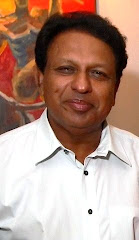
visit to the US is to be unrealistic,' says Ambassador T P Sreenivasan.
P
'To expect that he has a magic wand to resolve all
differences and announce breakthroughs in all issues during his first
visit to the US is to be unrealistic,' says Ambassador T P Sreenivasan.
Prime Minister Narendra Modi is
not a modern day Swami Vivekananda to conquer the West on his first
visit nor is he Pandit Jawaharlal Nehru to dazzle the world with his
charismatic diplomacy.
He is the new prime minister of India, a leader of the Bharatiya
Janata Party which opposed the India-US nuclear deal first and supported
the Nuclear Liability Act to deny US nuclear trade with India. He
became prime minister at a time when India-US relations were at a low
ebb and he himself was denied a US visa.
To expect that he has a magic wand to resolve all differences and
announce breakthroughs in all issues during his first visit to the US is
to be unrealistic.
As anticipated in these columns, Modi made a mark in the US, where
the image in the media and the public mind matter, he established
rapport with President Obama, reached agreements on the way to resolve
difficult issues and identified new areas of cooperation, in keeping
with his agenda for India's development and security.
The Vision Statement and the
Joint Statement contain the way forward in specific areas. Instead of
going for the low hanging fruit to show immediate achievements, the two
sides decided to work diligently to transform the relationship from the
transactional to the strategic.
Nuclear and arms trade on mutually acceptable terms, the combat
together against terrorism and fighting climate change are long-term
goals, which will immensely benefit the two countries and give the right
signals to the rest of the world. The joint Op-ed in the
Washington Post, a novel diplomatic tool, showed that the two leaders share a global view.
Nothing in Modi's domestic or foreign policy was a matter of concern
to Obama. Modi's domestic agenda, consisting of a liberalised and
foreign investment friendly economy and a strengthened defence sector is
conducive to the growth of India-US cooperation.
His neighbourhood policy and interactions with Japan, China, Russia,
Israel and Australia have given no reason for concern for the US.
His position on international terrorism that it is a crime against
humanity and that the ISIS's activities are a challenge to mankind,
against which all people should unite coincides with Obama's own
worldview.
His assertion that terrorism in India is not home grown and that
Indian Muslims will defeat Al Qaeda was much appreciated. On
Afghanistan, he hinted at a continuing role for the US in the troubled
nation.
Modi's maiden speech at the
United Nations was striking for its restraint and realism, though his
using a prepared text detracted from his usual oratorical flourish.
He was firm on Pakistan when he made it clear that India will engage
in a dialogue with Pakistan only in an atmosphere free of violence and
terrorism.
He dealt with the issue of terrorism in the larger context of the
world and called upon the United Nations to adopt a comprehensive
convention against terrorism, which India had proposed years ago.
He stated that India's whole philosophy is one of treating the whole
world as a family. He was restrained even when he spoke of the need for
expansion of the UN Security Council, as he did so without reiterating
India's own claim. He urged unity in the United Nations suggesting that,
instead of breaking into various groups, it should act as a 'G-All.'
The unprecedented rock star
reception accorded to Modi at the Madison Square Garden reflected the
genuine admiration and expectation on the part of Indian Americans that
he will transform India.
Indian Americans extend support to India selectively. They were
critical of Indian policies at times, but fully supportive on other
occasions, like at the time of the nuclear deal.
The Indian-American population, which is not only prosperous, but
also in crucial professions, has considerable influence. That explains
why several Senators and Congressmen, including the Chairman of the
Senate Foreign Relations Committee and the equivalent body in the House
and a Governor, were at hand to greet Modi.
The India Caucus in Congress and the Friends of India in the Senate
are the offshoots of the growing clout of Indian Americans in US
politics.
President Barack Obama cannot but take into account the tremendous
enthusiasm of the significant 1% of his people for the new leader of the
largest democracy. The very purpose of the Madison Square Garden
extravaganza was exactly that.
The Madison Square Garden event was more important for its symbolism
and implications for the future than for what was said or done there.
But Modi could be trusted to say the right things at the right time.
He harped basically on three themes -- how the overseas Indians,
particularly, Indian Americans, have raised India's standing and
prestige abroad, the greatness of India, old and new and his personal
promise to meet expectations by sheer dint of hard work.
Modi's image of the Indians of today playing with the computer mouse
rather than the proverbial snake was a compliment not only to India but
also overseas Indians who spearheaded the IT revolution in the world. He
thanked Indian Americans for keeping awake with bated breath during the
Indian elections, even though they could not participate in the vote.
Many had even gone to India to provide support to him, he said.
Modi was at his best in waxing
eloquent on Indian heritage and its potential. Gandhi created the
freedom movement and he is determined to create a clean India movement.
India is a young nation with an ancient history. With his penchant to
create alphabetical soups for all occasions, he spoke of three Ds this
time -- Democracy, Demographic Dividend and Demand -- which would drive
India.
As expected, Modi spoke eloquently about Mangalayan, the highly
successful Mars mission, which took India to the galaxy of four Mars
explorers. In Gujarat, an autorickshaw ride costs Rs 10 per kilometre,
but the journey to the Mars cost only Rs 7 per kilometre, an argument
against the charge of extravagance voiced by some. Though the Mars
mission was launched before Modi's emergence, he took full credit for
it.
Modi announced some consular
concessions to overseas Indians, but not the dual citizenship, the long
cherished dream of Indian Americans. Many had expected him to announce
it, going beyond the Person of Indian Origin card and the Overseas
Citizen of India card, put in place by previous governments.
He must have explored it and realised that dual citizenship was not
feasible for various reasons, including Constitutional constraints. A
lifelong visa for PIO cardholders is, however, an improvement. His own
visa issue appeared to be behind his comment that India was offering
visas on arrival to those who are reluctant to give visas to Indians.
Pepsico's Indra Nooyi encapsulated the American response, when she
said, 'Great Prime Minister, answers questions brilliantly. He is very
focused on improving India and we are ready to work with him.'
Also Read: India feels shortchanged
Ambassador T P Sreenivasan, (IFS 1967), is a former
Ambassador of India and Governor for India of the IAEA, Executive
Vice-Chairman, Kerala State Higher Education Council,Director General,
Kerala International Centre.
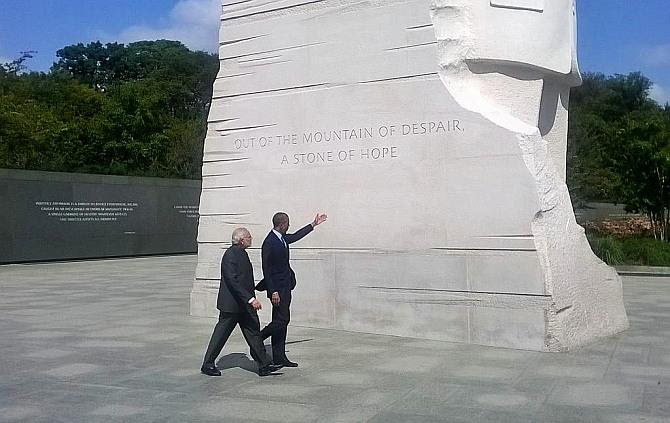
Image: Prime Minister Narendra Modi and President Barack
Obama at the Martin Luther King Jr Memorial in Washington, DC, September
30.