Tuesday, November 18, 2014

Countering Another String of Pearls


Countering another string of pearls


T. P. Sreenivasan
Comment   ·   print   ·   T  T  
MILITARY COUP TO DEMOCRACY: The timing of Prime Minister Narendra Modi’s visit to Fiji is appropriate as racial harmony and non-discrimination, which India had wished for Fiji, have been accomplished. Picture shows Fijian Prime Minister Frank Bainimarama waiting to cast his vote in the 2006 election before he seized power.
Photo: AP MILITARY COUP TO DEMOCRACY: The timing of Prime Minister Narendra Modi’s visit to Fiji is appropriate as racial harmony and non-discrimination, which India had wished for Fiji, have been accomplished. Picture shows Fijian Prime Minister Frank Bainimarama waiting to cast his vote in the 2006 election before he seized power.

Narendra Modi’s visit to Fiji has to be followed up with a robust programme of co-operation in areas in which India has particular strengths

For a handful of islands scattered on the Australia-U.S. trunk route in the Pacific, with less than a million people, Fiji is new to international rivalries. The South Pacific has been a western lake with the happy co-existence of the U.S., France and Australia, inevitably dominated by Australia’s commercial interests. Some ripples occasionally disturbed the placidity of these waters when Father Walter Lini, the maverick Prime Minister of tiny Vanuatu, hobnobbed with the erstwhile Soviets, when the island states protested against the French nuclear tests and disposal of waste on the atolls, when the indigenous people asserted their rights in Australia, New Zealand and Fiji, and when Libya’s Muammar Qadhafi did some sabre-rattling in the area. But these subsided and peace and tranquillity returned soon enough.
Political and protocol challengeThe arrival this week of the leaders of the two giants of Asia, India and China, who have also invited a dozen South Pacific leaders to meet them there, will be an unprecedented political and protocol challenge to Fiji. As a popular tourist destination, Fiji has enough luxury rooms to cater to the unusual group of diplomats in sartorial elegance, as against the tourists in bermudas and bula shirts and Fijians in Scottish kilts. But the political fallout of the visit will extend the tensions in the Asia Pacific to its southern corner.
Fiji was the first among the island states of the region to taste political upheavals, first on attaining independence from the British and then when the political compact between the native Fijians and the immigrant Fiji Indians collapsed on account of the first military coup in the region by Sitiveni Rabuka in 1987. India, in a reversal of its traditional policy of non-interference in such situations, fought for the rights of the Fiji Indians through economic sanctions and promoted their cause in the Commonwealth and the United Nations. By standing by Fiji Indians at a time of crisis, India sent a strong signal of solidarity to the Indian communities abroad. In the short term, the Fijians were concerned, but it dawned on them that it was the Indian position that led to the eventual return of democracy in the elections of 2014.
Although the present Prime Minister of Fiji, Rear Admiral (Rtd) Frank Bainimarama, first took power through a military coup, he concentrated on building communal harmony and creating a constitution devoid of the race-based electoral rolls, which was devised by the British. The abolition of the unelected Council of Chiefs removed the last vestiges of feudalism in Fiji. The moderates among the Fijians and the Fiji Indians supported him, leading to the removal of the racial divide in Fiji politics.
His Fiji First Party won an impressive victory even though the Social Democratic Liberal Party of the native Fijians and the National Federation Party, the traditional Fiji Indian Party, won some seats. Mr. Bainimarama had visited India twice to raise confidence among the Fiji Indians. As a nationally elected Prime Minister, he has no reason to be prejudiced against Indian influence in Fiji. His own senior advisers include Indian professionals and politicians such as Attorney General Aiyaz Sayed-Khaiyum.
India is certainly at an advantage in its bid to retain influence in the region, even as China is making sustained efforts to woo Fiji and the other islands in the South Pacific. In fact, India had no competitors in Fiji, as Pakistan had no presence and China had maintained only a token presence in the island country. China was focussed on seeking recognition from the islands, many of which had diplomatic relations with Taiwan. Having won that battle after many of them adopted the ‘One China’ policy, China has proceeded to befriend them with trade and economic linkages. The Chinese now have a firm foothold in the South Pacific, but with the kind of soft power it enjoys in the region, India can resist the expansion of Chinese influence in the South Pacific.
Relations with other islandsApart from Fiji, Tonga, Vanuatu and Nauru have cordial relations with India, while Papua New Guinea, Solomon Islands, Kiribati and others have warm feelings for India. The Indian brand is known in these islands mainly because of the Fiji Indian traders and businessmen. Nauru depends on India for teachers and administrators and had invested in the Paradeep Phosphates as part of its strategy to invest abroad in the context of its dwindling land. Tonga had a king who had a special relationship with Indian leaders and who had visited India. Vanuatu felt close to India because of its socialist dreams. At one time Australia had some apprehensions about the expansion of the Indian Navy in the Indian Ocean, but it doesn’t resent Indian influence in these islands now.
Unlike Japan and Vietnam, Australia has no major problems with China, and their commercial and economic relations are significant. This is a factor which will have an impact on the attitude of the South Pacific towards China. But the human rights violations in China, which Australia resents, must be a concern for the smaller state too. The only factor that weighs in favour of China in the region will be the massive investments that it promises to make in return for a market and strategic space in the South Pacific.
The visit of the Indian Prime Minister to Fiji comes 33 years after Indira Gandhi’s visit. But the timing of Narendra Modi’s visit is most appropriate because racial harmony and non-discrimination, both of which India had wished for Fiji, have just been accomplished. But the visit has to be followed up with a robust programme of co-operation in areas in which we have particular strengths. Indian businessmen tend to deal with those countries which give them the maximum profits, but other things being equal, they will be happy to source Indian products for the islanders.
Mr. Modi will receive a royal welcome, with popular participation. The Chinese President is likely to be received warmly, but only by the government. The contrast will be too obvious to be missed. Moreover, the arrival of the leaders of the other island states at the invitation of the Indian Prime Minister will be impressive. Mr. Modi will also address the Fiji Parliament in which the successors of the indentured labourers, who came to these islands in the 19th century, are represented. That will be an emotional moment. China appears to have plans to build another “string of pearls” in its favour in the South Pacific, mainly through trade and economic cooperation. India can effectively counter these moves if it makes use of its assets in the region.
(T.P. Sreenivasan was High Commissioner to Fiji and other South Pacific island states from 1986-89.)

Monday, November 03, 2014

Remembering the Iron Lady of India


Remembering the Iron Lady of India

 To get such articles in your inbox
Text size:  A   A   A
November 03, 2014 14:35 IST
It is unconscionable to choose between Sardar Patel, who united India physically, and Indira Gandhi, who gave meaning, content and pride to the unity of the nation and became a martyr at the altar of national unity, says Ambassador T P Sreenivasan.
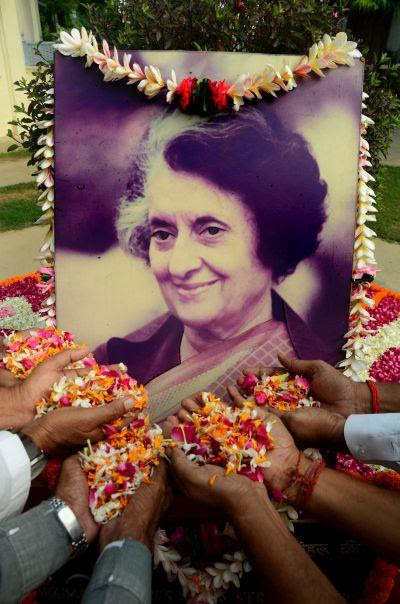
This year, on October 31, Indians were offered a Hobson’s choice between the Iron Man and the Iron Lady of India for veneration. Every patriotic Indian chose both, since it is unconscionable to choose between Sardar Patel, who united India physically, and Indira Gandhi, who gave meaning, content and pride to the unity of the nation and became a martyr at the altar of national unity.
Needless to say, a weak domestic policy cannot create a strong foreign policy and vice versa. Both should serve the developmental and security goals of the nation. As the prime minister from 1966 to 1977 and again from 1980 to 1984, Indira Gandhi pursued both with determination to become ‘the greatest PM of India’ (India Today’s survey) and ‘the Woman of the Millennium’ (BBC survey).
Richard Nixon may have called her a “witch” and a “clever fox”, but no one called her a “dumb doll” for long after she assumed office. She turned into a Durga in the eyes of an artist, and India itself in the words of her ardent followers.
Indira Gandhi may be remembered in history for her game-changing domestic legislations and actions, but her successes and visionary approach to foreign policy are no less significant.
The liberation of Bangladesh alone should secure a permanent place for her among the makers of the modern world. In one stroke, she eliminated the pincer of Pakistan on two sides of India and also won praise for liberating a people from the clutches of a dominant section of the country.
Mujibur Rahman, who was denied his right to rule the whole of Pakistan, was enabled to be the head of his “Golden Bengal”.
Indira Gandhi had no qualms to sign a Treaty of Friendship with the Soviet Union, which had a provision that any attack on either country will be construed as an attack on the other. Where is nonalignment, asked critics. But she was not concerned about such technicalities. Foreign policy is meant to serve the nation, not to confine itself to definitions.
The concept of nonalignment was broadened to cover the freedom to choose friends and allies. The Treaty kept the American fleet and the Chinese dragon at bay when the Indian army fought side by side with the “Mukti Bahini” till the Pakistan commander, General Niazi, signed the instrument of surrender, ushering in the advent of two nations -- a liberated Bangladesh and an invigorated India. Never before had India been such a dominant power in South Asia.
Indira Gandhi was as gracious in peace as she was fierce in war. She returned the Pakistani soldiers and the territory in the west and signed the Simla Agreement to begin the ending of the Kashmir issue.
When she agreed to turn the ceasefire line into a Line of Control, with adjustments to follow geographical features, she believed that Pakistan would eventually recognise it as the international border.
Whether Zulfikar Ali Bhutto had a secret agreement with her or not, he had explicitly vowed to keep the issue within the bilateral framework. No wonder, Pakistan hanged the Simla Agreement, together with Bhutto.
Indira Gandhi’s position on Afghanistan, that the Soviet troops would help maintain stability in the country, and her recognition of Kampuchea were clearly pro-Soviet in the eyes of the world, but she would not accept the Soviet notion of ‘Collective Security in Asia’, which would have landed her in the Soviet camp. Her management of the cold war was as masterly as the hot war in Bangladesh.
The decision to conduct a “peaceful” nuclear explosion in 1974 did not please the Soviets, but since they and the Americans had turned down her request for a nuclear umbrella in return for signing the Nuclear Non-proliferation Treaty, they could not protest too much or impose sanctions.
It took a gritty Iron Lady to pave the way for the declaration of India as a de facto nuclear weapon state in 1998 by Atal Behari Vajpayee. It was quite amusing that some States, which insisted that India had become a nuclear weapon State in 1974, maintained that India had not become a weapon State on account of the tests in 1998.
Palestine was a matter of faith for India from the beginning and Indira Gandhi stood firm and developed a cordial relationship with Yasser Arafat. But she had the foresight not to isolate Israel altogether. India had recognised Israel and had consular linkages with it.
She had quietly authorised contacts with Israel to benefit from Israel’s strength in agriculture, irrigation and security. She had laid the foundations of a flourishing relationship with Israel, which developed after Prime Minister P V Narasimha Rao established full diplomatic relations with that country.
Indira Gandhi’s uncanny ability to anticipate global developments and to take precautionary positions was best demonstrated when she decided to go to Stockholm to attend an environment conference in 1972. She was the only prime minister other than the host to attend the conference, as against more than a hundred global leaders who went to Rio in 1992.
She presciently sensed that the Stockholm conference was the beginning of an effort to usher in environmental colonialism. She saw how the West, having unscrupulously engaged in conspicuous consumption of the resources of the earth, was planning to deny development to the developing countries by imposing environmental conditionalities.
The questions she asked in Stockholm -- like “are not poverty and need the greatest polluters?” -- reverberated in the debate that developed regarding the linkages between environment and development and gave rise to the demand of the developing countries that “polluters must pay” for the regeneration of nature.
The assertion made by her, that the West had the main responsibility to take remedial measures, led to the compromise in Rio that all of us had “common, but differentiated responsibilities”. The Indian negotiators on climate change in Rio used the formulations of Indira Gandhi with decisive effect.
The signing of the Antarctic Treaty in 1983 to obtain consultative status for India was another significant measure Indira Gandhi took by stepping away from the consensus within the nonaligned movement, which wanted to leave Antarctica as a common heritage of mankind.
She did not want to remain outside an arrangement, which set aside Antarctica as a scientific preserve and established freedom of scientific investigation and banned military activity on that continent. She was not deterred by the fact that the Treaty was an arms control agreement among the states, which had territorial claims.
Apart from facilitating research by India on the icy continent, she ensured that India would be consulted on any future dispensation that may emerge on the continent.
In a single letter, Sardar Patel taught the architect of Indian foreign policy, Pandit Jawaharlal Nehru, a couple of lessons on China. If Pandit Nehru had heeded his advice, India-China relations would have taken a different turn.
Indira Gandhi fearlessly protected and promoted Indian interests by turning her father’s “moral politik” to realpolitik. Her timely moves in the international arena gave India immense strength.
Both Patel and she deserve our gratitude and reverence now and forever.
T P Sreenivasan is a former Ambassador of India and Governor for India at the International Atomic Energy Agency; Executive Vice-Chairman, Kerala State Higher Education Council; and Director General, Kerala International Centre.
You can read Ambassador Sreenivasan's earlier columns here.
Photograph: Floral tributes being offered to former prime minister Indira Gandhi on her death anniversary on October 31, 2014. Photograph: PTI Photo

Saturday, November 01, 2014

Advance Praise for Applied Diplomacy Through the Prism of Mythology


Applied Diplomacy Through the Prism of Mythology: Endorsements


T.P.Sreenivasan, a master of multilateral diplomacy and advocate of international and Indian environmental action long before it was so fashionable to be, is that admirable global actor--more rooted at home than to a peripatetic
lifestyle. And when home in Thiruvananthapuram, why ever not? A very sharp thinker, elegant but unsentimental writer and a generous friend, this volume will reward expert writers and novices alike.
David M Malone, UN Under Secretary General
I have known the prolific and often surprising Ambassador T. P. Sreenivasan in his many incarnations over more than a quarter of a century. Divya S.Iyer, with the uncanny link that she has established between diplomacy and mythology, adds value to this extraordinary output in this well-edited volume.
Shashi Tharoor, Member of Parliament
Divya S.Iyer has done her mentor, Ambassador Sreenivasan proud, by bringing together several of his thought-provoking and erudite contributions, on a whole range of subjects, in a most imaginatively structured compilation. Providing a running thread with India's own classical and religious traditions, she weaves Sreenivasan's wide-ranging  offerings into a coherent whole, illuminating the conceptual as well as experimental underpinning of her mentor's thoughts. A most creatively conceived gurudakshina to one of India's leading thought leaders on his seventieth birthday.
Shyam Saran, former Foreign Secretary of India
Ambassador T. P. Sreenivasan's writings are delightful and thought-provoking , laced with humour. As is to be expected, borne by his earlier books, most of them are about diplomacy, strategic affairs and global institutions. Somewhat unexpectedly, (for those who do not know, like me), there are writings on Kerala too and a bunch of essays that can only be described as a potpourri. Apart from making you think, they will bring a smile to your lips---a rare trait of any author. The essays have been attractively edited and brought together by Divya S.Iyer, with a dash of mythology thrown in. The mythology won't be obvious until you read the essays. Those are some very good reasons for reading the book

Bibek Debroy, Professor, Centre for Policy Research


Ambassador T. P. Sreenivasan has deftly popularised the art of statecraft and foreign affairs in India and reached out to a wider public to educate them about the nuances and constraints of diplomacy. This book reveals an interesting facet of Hindu mythology and its lessons for the conduct of diplomacy. It is a must read for everyone interested in the intersection of world politics and culture. A fascinating  collection of writings by a legend in India's foreign policy fraternity. Divya Iyer, the editor, with her deep interest in mythology has grouped the writings into chapters linked to seven legendary sages and shown how the conduct of diplomacy merges with mythology.
Sreeram Chaulia, Professor and Executive Director, JSIA

Monday, October 20, 2014

Technology Based Education


Inaugural Remarks by Former Ambassador T.P.Sreenivasan at the Seminar on Technology Enabled Education at the Chinmaya Institute of Technology at Kannur
Oct 20, 2014

I am grateful to Dr.K.R.Srivathsan and his colleagues for organizing this timely seminar on technology-enabled education. This is a matter of high priority for the Kerala State Higher Education Council, which has set up a Committee on IT@Colleges, of which Dr.K.R.Srivathsan is a leading member. The Committee has a two-fold agenda. The first is to assess the IT assets that our educational institutions have to enable them to make optimum use of the different platforms available and to provide additional facilities to them. The second is to design the necessary content to facilitate the use of the platforms in accordance with the syllabi of our universities. I hope that the present seminar will provide the necessary inputs to our Committee. As is well known, the key to effective use of technology in education is the design.

A year ago, the KSHEC organized an International Meet on Transnational Education and issued a Thiruvananthapuram Declaration, which emphasized, among other things, the need to popularize MOOCS in the state to fill the gap between the knowledge of the teachers and advanced knowledge, which is freely available in cyberspace. We faced some criticism from high places, which pointed out that India did not have either the connectivity or even the electricity to use MOOCS. What we had suggested was not to replace traditional education with MOOCS, but to use MOOCS as tools to supplement classroom education. Today, however, there is recognition of the central role of MOOCS in higher education. The President, the Prime Minister and the MHRD Minister have spoken of MOOCS as an essential tool. Dubbed as SWAYAM, (Study of Webs of Active learning for Young aspiring Minds) MOOCS have been generated in India with the involvement of UC Berkley and IIT Mumbai.

In our own way, we have incorporated MOOCS in our teachers training programmes and held several workshops. Together with the University of North Carolina, the Mahatma Gandhi University has held a MOOCS programme for University students. Since we propose to move rapidly in this direction, we need to create the necessary content to suit our curricula.

Distance learning is not entirely new and different forms of distance learning have existed for long. Educational films were produced as early as 1910 and Thomas Edison said in 1913 that there is no branch of human knowledge, which cannot be taught with motion pictures. Technology has transformed education in the last ten years and in the next ten years, it will reach unprecedented levels of innovation. India needs to catch up with these developments to keep our higher education relevant, competitive and efficient. Technology and education can promote each other, if they are used with reason and vision.

The variety of learning tools available can be used to enable the teachers and the students to use online resources and to develop research skills. Flipped classrooms have proved effective and technology is particularly suited for Math, which is fundamental to the growth of technology. Unless our universities specialize in research and create knowledge, rather than gather information, we can never reach the world-class levels of education we aspire to. We do not have world-class universities in India not because they are poor, but because the criteria used are applicable more for research universities, not teaching universities.

Some say that universities, the way we know them, will disappear with the growth of technology. I do not subscribe to this view. Learning cannot be imparted by machine alone. Interaction with teachers and peers are extremely important to embellish education. Resources available in cyberspace should be used with discretion and on the basis of mentoring by teachers.

Nobody can be enthusiastic about technology without being skeptical at the same time. We cannot take effective technology for granted even in the advanced countries. Failure of technology has resulted in heavy losses, not to speak of the embarrassment it causes to technologists. I have seen technology failure in seemingly minor technologies even in MIT and NASA. Once I was with Ambassador (later President) K.R.Narayanan at MIT and when he stood up to speak, the microphone failed. Ambassador Narayanan said that if it had happened in his village, it would be called “third world technology”, but since this is MIT, we can only call it “system failure!” On another occasion, when Kalpana Chawla was about to take off on her first shuttle mission, I was told I could greet her from the NASA headquarters. The system failed and later, we discovered that someone had unplugged the device under the table! If such things can occur in MIT and NASA, how can we rely on technology in the conditions that exist in our universities? The answer, of course, lies in the mastery of man over the machine. Needless to say, we have to reach higher levels of technology to use it uninterruptedly on the education scene.

With these words, may I inaugurate the Seminar and wish it every success? We have a major stake in your success as we propose to use your conclusions in reforming education in Kerala.

Thank you.


Thursday, October 16, 2014

The Nobel Prize: Pride and Prejudices


Nobel Prize: Pride and Prejudices

T.P.Sreenivasan

The announcement of the Nobel Peace Prize for India's Kailash Satyarthi and Pakistan's Malala Yousufsai during serious India-Pakistan border skirmishes led to speculation that it was meant to urge India and Pakistan to stop firing across the border and move to the negotiating table, though the decision was taken long before the present ceasefire violations by Pakistan. The Nobel Committee is being portrayed as a peacemaker. Malala herself has dramatized the situation by inviting the Prime Ministers of India and Pakistan to attend the Prize ceremony in Oslo. This is far fetched because the award has nothing to do with India-Pakistan relations or the border conflict. India would reject any such linkage as it is likely to lead to external intervention.

Another twist to the award was added by the Nobel Committee by referring to a Hindu in India and a Moslem in Pakistan struggling together for the rights of the children, reflecting he stereotyped approach to the religions in the two countries. Satyarthi himself has denied that his work had anything to do with his religion. 

Both India and Pakistan are legitimately proud of their Nobel laureates of 2014, Kailash Satyarthi and Malala Yousufsai, but the award may reflect some prejudices about the sub-continent. Except in a very few cases, Nobel Prize for Peace has become a disruptive tool of intervention in the developing world. In the present case, the motivation was not just to honor two exceptional achievers, but to invite attention to the miserable state of children in India and Pakistan, without any regard to the social and economic conditions in the two countries. Often, such attention can lead to new conditionalities for development assistance.

It was the European Parliament, not any Indian entity, which nominated Kailash Satyarthi for the Nobel Prize. His long list of awards have come from the US, Italy, Germany and Spain. The reason is that Satyarthi’s struggle for the rights of the children in India was used as a part of the western agenda to impose their standards on India. At the UN and in the US, we have been bombarded about child labour with the material and evidence given to them by Satyarthi and his organization. Like Amnesty International and Human Rights Watch, Satyarthi's work has often embarrassed India by challenging the reports we have submitted to international organizations.

India has been a champion of the International Convention on the Rights of the Child and Indian representatives largely wrote it. But the formulation in it on child labour made it difficult for us to sign and ratify it. Totally forbidding any employment of children below the age of 14 in any sector would be neither practical, nor desirable in India. India tried to sign the Convention with a reservation on the child labour clause, but this was not acceptable to the UN. While India was exploring various ways to  join the Convention, we were under severe pressure from various international NGOs. Eventually, we signed and ratified the Convention on the understanding that we would implement the child labour clause in a progressive manner.

In the US, the then President Clinton had also campaigned for the abolition of child labour in India, using the work of Satyagrahi and others to prove that India had no concern for the plight of Indian children. The “Rug Mark”, instituted by Satyarthi to identify Indian carpets, which were made without child labour resulted in the reduction of carpet exports from India. This had become an irritant in India-US relations even when Clinton was forging new ties with India. The memories of the miserable conditions of children during the Industrial Revolution in Europe should have tempered the criticism against India.

Today, when Satyarthi is being honoured with the most prestigious global award, reports appear to the effect that many millions of Indian children are in “slavery”. This is hardly the reputation that India should have when we are basking in the glory of “Mangalyan”. That India is conscious of the rights of its children and that every effort is being made to end child labour is lost in the bustle of an Indian winning the Nobel Prize. Satyarthi’s comments after winning the Prize on a recent case of alleged child trafficking in Kerala without evidence has angered many in the state.

Malala Yousufsai was widely believed to win the Nobel last year, but, to the disappointment of her admirers, the award went to the Organization for the Prohibition of Chemical Weapons (OPCW) in the wake of the destruction of chemical weapons of Syria. One of the reasons cited for not giving the Prize to Malala last year was her young age and the fear that the Prize might provoke Taliban to hurt her. These considerations are still valid, but the pressure to give her the Prize came from very powerful groups, essentially because of clever marketing by her father. She had captured the imagination of the west because of her book and her acclaimed speech at the UN. Her courage and near sacrifice are unparalleled and she fully deserved the Prize.

The interventionist aspect is evident in the case of Malala as well. The stereotyped image of Islamic countries consists of denial of education to women and prevalence of terrorism. Nothing illustrates this image more than the Malala incident. It is believed that she survived basically because she was shifted to Birmingham and received outstanding medical treatment. Pakistan is certainly embarrassed that Malala has received such international attention. Even though Malala aspires to political leadership in Pakistan, she has not chosen to return to Pakistan. Her Nobel Prize is the second in history of Pakistan, which makes the country feel proud, but not without a tinge of embarrassment.

The Nobel Prize for those who have many more years in social activism can cause complications in their work. Their dramatic rise in stature may impel them to be more daring. Unless they measure their steps carefully in the future, their messianic zeal may hurt rather than help their causes. Praveen Swami went to the extent of saying that the Prize is “ephemeral, arbitrary and ultimately banal” and not different from beauty contests. This may be an exaggeration, but for both India and Pakistan, the Nobel Prize for Satyarthi and Malala may be a mixed blessing.

The UN is 69, Going on 70


UN is 69, going on 70!
An AIR Talk
By T.P.Sreenivasan
In human lives, 70 is the age at which one senses the approaching dusk and begins to evaluate the accomplishments and disappointments. But for the UN, which is meant to survive many generations, being on 69, going on 70 is youth as yet, ready to fulfill expectations and explore new horizons. As the UN prepares for its 70th birthday next year, the world rejoices over its achievements, assigns new responsibilities to it and sets its new goals. New challenges, like the Ebola virus stare the UN in the face, while the festering issues of the past continue to defy solutions.
Leaders, who addressed the 69th session of the UN General Assembly made their appraisals of the UN from their own respective perspectives and outlined its future course. Much needs to be done, much needs to be corrected, and much needs to be innovated, they said. Each added at least a new agenda item; each proposed a new initiative, a new Year, a Month or a Day to be designated for one cause or another. Although the UN is not considered effective enough, it still remains the only universal body with a global agenda.
The UN has much to be proud of. The historic challenge of decolonization was met and the exponential growth in its membership itself is testimony to the birth of many nations with the least possible pain. Without the UN, disarmament and non-proliferation will not have registered even modest success. Equity and justice in global economy have been defined, if not achieved. The standards set for the promotion and protection of human rights serve as models of national behavior even if many nations deviate from them. The new challenges like the environment, cyber threats, management of outer space and various pandemics have also been tackled. The Specialized Agencies work in their areas effectively. There is no human activity, which the UN has not touched.
Admittedly, the UN has, however, not fulfilled its primary purpose, which is to rid the world of the scourge of war. More than 800 wars have been waged in the last 70 years and many others are in the offing. Peacemaking, peacekeeping and peace building have made an impact in conflict areas, but lack of authority and effective machinery have rendered several such missions unable to fulfill their mandate. Powerful countries manipulate the UN to suit their purposes and defy the UN even when it reflects the international will. The millennium goals remain more as benchmarks, rather than accomplished missions.
The UN has shown remarkable resilience in dealing with global issues to the extent that the members, particularly the permanent members have the will to let it act. The UN can be only as effective the members want it to be. While it has been successful in expanding the agenda over the years, it has not been able to get rid of the old baggage. Closing an agenda item is much harder than adding one. Much time is spent, therefore, in reiterating positions and repeating old arguments. The UN is the most conservative of organizations, with very little room for innovation in its methodology and practices. There are too many sleeping dogs allowed to lie around, with the threat that one side or another will wake them up and create havoc.
Leaders, including our Prime Minister expressed the hope that the long awaited reform of the Security Council will be accomplished on the occasion of the 70th birthday of the UN. But this was said, as far as I know, on the 50th and 60th birthdays also. As of now, there is no formula for the expansion of the Security Council, which can command the support of two-thirds of the membership of the General Assembly, including the permanent members of the Security Council. Everyone understands the logic for change. They know that the realities of global power have changed beyond recognition. They know that the ratio of General Assembly members and the Security Council members is extremely low. But those who have enjoyed privileged positions for 69 years are not going to give them up in the 70th year. India’s claim for permanent membership of the Security Council is well established, but there is no chance for it to be recognized in the 70th year. No wonder that our Prime Minister spoke on the subject in general terms, without making any claim. Our ambition in this regard has been tempered by experience.
The environment, particularly climate change, has been established as the one issue on which a global consensus is imperative in 2015. The Secretary General has already hosted a summit to focus attention on climate change. The consensus of Rio collapsed in Copenhagen and today, there is not even a basis for a new global agreement. Polluters are yet to pay and the international community is yet to fulfill their common, but differentiated responsibilities. In the meantime, anthropogenic emissions of greenhouse gases continue to accumulate beyond permissible levels, threatening the very existence of mankind.
Terrorism is the other issue on which the UN needs to develop a consensus. In the wake of 9/11, there was a renewed desire to approve a Comprehensive Convention on Terrorism, but that has been lost, once again, in the terrorist vs freedom fighter debate. One man’s freedom fighter is another man’s terrorist and vice versa. If countries have adopted terrorism as their national policy, they will not condemn terrorism in all its manifestations. Al Qaeda has made new threats against India and the stirrings of fundamentalism in Iraq and Syria threaten to engulf West Asia. Scenes of abominable executions have added a new dimension to human depravity and cruelty. 
Can nuclear disarmament and non-proliferation become a reality in the 70th year of the UN? Nuclear security has become a priority and safety has become a matter of of paramount importance after Fukushima. But on the fundamental issue of elimination of nuclear weapons, which had gained momentum a few years ago, has become dormant again. When countries, which have signed the NPT engage in surreptitious nuclear weapons activities, elimination of nuclear weapons cannot take place. As long as nuclear weapons remain at the centre of defense strategies, there is little hope of a world without nuclear weapons. The use of nuclear energy for peaceful purposes has also suffered a setback after Fukushima.
Much effort was made to turn the Human Rights Commission into the Human Rights Council, but it has changed only in name. Politicization of human rights continues. Political opponents are suppressed or eliminated in the name of human rights.
The fight against the Ebola virus will be the most urgent issue for the UN to tackle in its 70th year. It has already reached the shores of the United States and no nation can remain immune to it in a globalized world. Even the modest success accomplished in the case of HIV/AIDS may elude the UN and rapid action is necessary. Such pandemics do not recognize national boundaries or distinctions of race and ideology. The UN has the responsibility to meet the threat on a war footing.
Another tendency, which will jeopardize the UN in the 70th year is the propensity of powerful countries to act as coalitions of the willing when the Security Council is unwilling or unable to act. Today, most of the concerns of the US are outside the UN, whether it is the power struggle in the Asia Pacific, the dispute over the South China Sea or the change in Afghanistan. The absence of a UN framework leaves the field to the powerful nations.
India today has gained enough experience to know that it is unrealistic to expect to gain anything by taking up issues to the UN. Instead, we focus on the global commons and contribute ideas and efforts to build the capacity of the UN to deal with the new challenges. We do not ask what we can get from the UN, but we do what we can to advance the common good. India has abiding faith in the UN, despite its weaknesses and setbacks.
What can we expect the UN to accomplish in the 70th year? Not much, I am afraid. It will continue to be a forum for international discourse, it will be seen as the conscience of humanity, it will set new targets and new standards, which may not be met. It will remain a beacon of hope for humanity, as it embodies the aspirations of all nations, big and small, the powerful and the weak. In the ultimate analysis, at 70, the UN as a symbol of hope is more valuable than the sum total of its achievements.
Thank you.


Sunday, October 05, 2014

My Tehelka Article on the Modi Visit


 Modi Makes a Mark in America

By T.P.Sreenivasan

Prime Minister Narendra Modi joins President Barack Obama at the White House dinner table at the end of his first round of consultations with who is who on the global scene. He has met the heads of India’s neighbouring countries, attended the BRICS summit, visited Bhutan, Nepal and Japan and played host to the leaders of China and Australia, not to speak of many others leaders, who came calling. In the US itself, he made a mark at the United Nations with a restrained and forward looking speech and received a rock star style welcome from Indian Americans. At his meeting with the CEOs of major US corporations and at the Council on Foreign Relations, he spoke impressively on his economic and international agenda.

The significance of Modi’s meeting at the White House is that it will resuscitate a strategic partnership between India and the US, which had remained on hold for nearly five years on account of paralysis of the Government in India and other preoccupations in the United States. Obama cannot but take note of the events of the last three months of Modi’s performance in India and abroad as he sizes up the man who has taken up the reins of the largest democracy in the world.

Nothing in Modi’s domestic or foreign policy should be a matter of concern to Obama. Modi’s domestic agenda, consisting of a liberalized and foreign investment friendly economy and a strengthened defense sector is conducive to the growth of India-US cooperation. His neighbourhood policy and interactions with Japan, China, Russia, Israel and Australia have given no reason for concern for the US. His position on international terrorism that it is a crime against humanity and that the ISIS activities are a challenge to mankind, against which all people should unite coincides with Obama’s own worldview. His assertion that terrorism in India is not home grown and that Indian Muslims will defeat Al Qaeda would be much appreciated. On Afghanistan, he hinted at a continuing role for the US in the troubled nation. Therefore, even if all the irritants in India-US relations are not removed at their first meeting, the two leaders are sure to hit on well.

Modi’s maiden speech at the United Nations was striking for its restraint and realism, though his using a prepared text detracted from his oratorical skills. He was firm on Pakistan when he made it clear that India will engage in a dialogue with Pakistan only in an atmosphere free of violence and terrorism. He dealt with the issue of terrorism in the larger context of the world and called upon the United Nations to adopt a comprehensive convention against terrorism, which India had proposed years ago. He stated that India’s whole philosophy is one of treating the whole world as a family. He was restrained even when he spoke of the need for expansion of the UN Security Council, as he did so without reiterating India’s own claim. He urged unity in the United Nations suggesting that, instead of breaking into various groups, it should act as a “G-All”.   

The unprecedented rock star reception accorded to Modi at the Madison Square Garden (MSG) reflected the genuine admiration and expectation on the part of the Indian Americans that he will transform India. The Indian Americans extend support to India selectively. They were critical of Indian policies at times, but fully supportive on other occasions, like at the time of the nuclear deal.

The 1% Indian American population, which is not only prosperous, but also in crucial professions, has considerable influence. That explains why several Senators and Congressmen, including the Chairman of the Senate Foreign Relations Committee and the equivalent body in the House and a Governor were at hand to greet Modi. The India Caucus in the Congress and the Friends of India in the Senate are the offshoots of the growing clout of the Indian Americans in US politics. President Barack Obama cannot but take into account the tremendous enthusiasm of the significant 1% of his people for the new leader of the largest democracy. The very purpose of the Madison Square Garden extravaganza was exactly that. Of course, Obama had anticipated the phenomenon when he appointed Nisha Biswal, Arun Kumar and now Richard Verma to take care of crucial positions in the US administration.

The MSG event was more important for its symbolism and implications for the future than for what was said or done there. But Modi could be trusted to say the right things at the right time. He harped basically on three themes---how the overseas Indians, particularly, Indian Americans, have raised India’s standing and prestige abroad, the greatness of India, old and new and his personal promise to meet the expectations by sheer dint of hard work.

Modi’s image of the Indians of today playing with the computer mouse rather than the proverbial snake was a compliment not only to India but also the overseas Indians, who spearheaded the IT revolution in the world. He thanked the   Indian Americans for keeping awake with bated breath during the Indian elections, even though they could not participate in the vote. Many had even gone to India to provide support to him, he said.

Modi was at his best in waxing eloquent on Indian heritage and its potential. Gandhi created the freedom movement and he is determined to create a clean India movement. Indian is a young nation with an ancient history. With his penchant to create alphabetical soups for all occasions, he spoke of three Ds this time--Democracy, Demographic dividend and Demand—which would drive India. Having not taken even a “fifteen minutes vacation” since he assumed office, he would work tirelessly to keep up the promise he had given to the people.
He invited every one to participate in the Make in India program.

As expected, Modi spoke eloquently about ‘Mangalayan’, the highly successful Mars mission, which took India to the galaxy of four Mars explorers. In Gujarat, an auto rikshaw ride costs rupees ten per kilometer, but the journey to the Mars cost only rupees seven per kilometer, an argument against the charge of extravagance voiced by some. Though the Mars mission was launched before Modi’s emergence, he took the full credit for it.

Modi announced some consular concessions to overseas Indians, but not the dual citizenship, the long cherished dream of the Indian Americans. Many had expected him to announce it, going beyond the Person of Indian Origin (PIO) card and the Overseas Citizen of India (OCI) card, put in place by previous Governments. He must have explored it and realized that dual citizenship was not feasible for various reasons, including constitutional constraints. Lifelong visa for PIO card holders is, however, an improvement. His own visa issue appeared to be behind his comment that India was offering visa on arrival to those who are reluctant to give visas to Indians.

Modi was unconcerned about
the fact that he was addressing essentially foreign nationals , who owe their allegiance to the US than to India. He also ignored the fact that many of them did not follow Hindi. In fact, some in the audience had challenged Atal Behari Vajpayee in 2000, when he spoke in Hindi at an Indian community function in Washington. When Vajpayee said that that he had spoken in Hindi even at the UN, he was told that he had the facility of simultaneous interpretation at the UN. At MSG, the mood was so exuberant that what he said was less important than the privilege of being with him.

Modi did not dwell at length on India-US relations, even though US policy makers were present, perhaps because he wanted to hold his horses till he reached Washington. But the word must have reached Obama loudly and clearly that a significant 1% of his people saw Modi as a messiah of change in India and that partnership with him will benefit the US in meeting the global challenges of the future. The euphoria of MSG will definitely reverberate in the White House and the man, who was once a Persona Non Grata in the US, will be warmly received. Obama is sure to seek his counsel on Ukraine, ISIS, South China Sea and Afghanistan and seek to resolve problems relating to the nuclear deal, defense cooperation and investment.

The Modi magic is bound to make an impact on Obama and the American public. More than anything else, his message of peace, non-violence, development and a liberalized economy has been carried to the wide American public opinion. Pepsico’s Indra Nooyi encapsulated the American response, when she said, “Great Prime Minister, answers questions brilliantly. He is very focused on improving India and we are ready to work with him.”

Thursday, October 02, 2014

Rediff Column on Narendra Modi's Visit to the US


Transforming the relationship: From the transactional to the strategic


October 02, 2014 17:07 IST
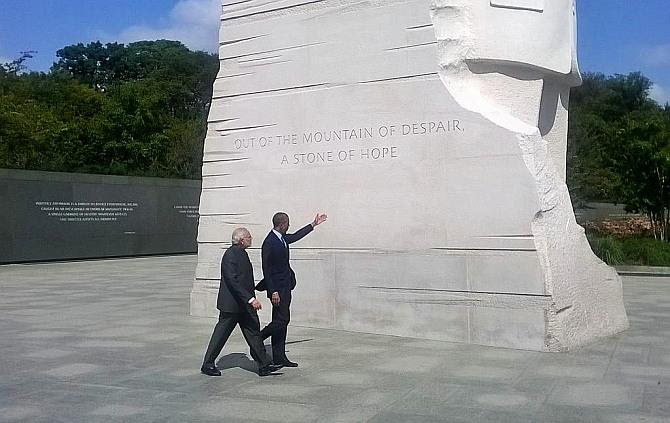
Prime Minister Narendra Modi and President Barack Obama at the Martin Luther King Jr Memorial in Washington, DC, September 30.
'To expect that he has a magic wand to resolve all differences and announce breakthroughs in all issues during his first visit to the US is to be unrealistic,' says Ambassador T P Sreenivasan.
Prime Minister Narendra Modi is not a modern day Swami Vivekananda to conquer the West on his first visit nor is he Pandit Jawaharlal Nehru to dazzle the world with his charismatic diplomacy.
He is the new prime minister of India, a leader of the Bharatiya Janata Party which opposed the India-US nuclear deal first and supported the Nuclear Liability Act to deny US nuclear trade with India. He became prime minister at a time when India-US relations were at a low ebb and he himself was denied a US visa.
To expect that he has a magic wand to resolve all differences and announce breakthroughs in all issues during his first visit to the US is to be unrealistic.
As anticipated in these columns, Modi made a mark in the US, where the image in the media and the public mind matter, he established rapport with President Obama, reached agreements on the way to resolve difficult issues and identified new areas of cooperation, in keeping with his agenda for India's development and security.
The Vision Statement and the Joint Statement contain the way forward in specific areas. Instead of going for the low hanging fruit to show immediate achievements, the two sides decided to work diligently to transform the relationship from the transactional to the strategic.
Nuclear and arms trade on mutually acceptable terms, the combat together against terrorism and fighting climate change are long-term goals, which will immensely benefit the two countries and give the right signals to the rest of the world. The joint Op-ed in the Washington Post, a novel diplomatic tool, showed that the two leaders share a global view.
Nothing in Modi's domestic or foreign policy was a matter of concern to Obama. Modi's domestic agenda, consisting of a liberalised and foreign investment friendly economy and a strengthened defence sector is conducive to the growth of India-US cooperation.
His neighbourhood policy and interactions with Japan, China, Russia, Israel and Australia have given no reason for concern for the US.
His position on international terrorism that it is a crime against humanity and that the ISIS's activities are a challenge to mankind, against which all people should unite coincides with Obama's own worldview.
His assertion that terrorism in India is not home grown and that Indian Muslims will defeat Al Qaeda was much appreciated. On Afghanistan, he hinted at a continuing role for the US in the troubled nation.
Modi's maiden speech at the United Nations was striking for its restraint and realism, though his using a prepared text detracted from his usual oratorical flourish.
He was firm on Pakistan when he made it clear that India will engage in a dialogue with Pakistan only in an atmosphere free of violence and terrorism.
He dealt with the issue of terrorism in the larger context of the world and called upon the United Nations to adopt a comprehensive convention against terrorism, which India had proposed years ago.
He stated that India's whole philosophy is one of treating the whole world as a family. He was restrained even when he spoke of the need for expansion of the UN Security Council, as he did so without reiterating India's own claim. He urged unity in the United Nations suggesting that, instead of breaking into various groups, it should act as a 'G-All.'
The unprecedented rock star reception accorded to Modi at the Madison Square Garden reflected the genuine admiration and expectation on the part of Indian Americans that he will transform India.
Indian Americans extend support to India selectively. They were critical of Indian policies at times, but fully supportive on other occasions, like at the time of the nuclear deal.
The Indian-American population, which is not only prosperous, but also in crucial professions, has considerable influence. That explains why several Senators and Congressmen, including the Chairman of the Senate Foreign Relations Committee and the equivalent body in the House and a Governor, were at hand to greet Modi.
The India Caucus in Congress and the Friends of India in the Senate are the offshoots of the growing clout of Indian Americans in US politics.
President Barack Obama cannot but take into account the tremendous enthusiasm of the significant 1% of his people for the new leader of the largest democracy. The very purpose of the Madison Square Garden extravaganza was exactly that.
The Madison Square Garden event was more important for its symbolism and implications for the future than for what was said or done there. But Modi could be trusted to say the right things at the right time.
He harped basically on three themes -- how the overseas Indians, particularly, Indian Americans, have raised India's standing and prestige abroad, the greatness of India, old and new and his personal promise to meet expectations by sheer dint of hard work.
Modi's image of the Indians of today playing with the computer mouse rather than the proverbial snake was a compliment not only to India but also overseas Indians who spearheaded the IT revolution in the world. He thanked Indian Americans for keeping awake with bated breath during the Indian elections, even though they could not participate in the vote. Many had even gone to India to provide support to him, he said.
Modi was at his best in waxing eloquent on Indian heritage and its potential. Gandhi created the freedom movement and he is determined to create a clean India movement. India is a young nation with an ancient history. With his penchant to create alphabetical soups for all occasions, he spoke of three Ds this time -- Democracy, Demographic Dividend and Demand -- which would drive India.
As expected, Modi spoke eloquently about Mangalayan, the highly successful Mars mission, which took India to the galaxy of four Mars explorers. In Gujarat, an autorickshaw ride costs Rs 10 per kilometre, but the journey to the Mars cost only Rs 7 per kilometre, an argument against the charge of extravagance voiced by some. Though the Mars mission was launched before Modi's emergence, he took full credit for it.
Modi announced some consular concessions to overseas Indians, but not the dual citizenship, the long cherished dream of Indian Americans. Many had expected him to announce it, going beyond the Person of Indian Origin card and the Overseas Citizen of India card, put in place by previous governments.
He must have explored it and realised that dual citizenship was not feasible for various reasons, including Constitutional constraints. A lifelong visa for PIO cardholders is, however, an improvement. His own visa issue appeared to be behind his comment that India was offering visas on arrival to those who are reluctant to give visas to Indians.
Pepsico's Indra Nooyi encapsulated the American response, when she said, 'Great Prime Minister, answers questions brilliantly. He is very focused on improving India and we are ready to work with him.'
Also Read: India feels shortchanged
Ambassador T P Sreenivasan, (IFS 1967), is a former Ambassador of India and Governor for India of the IAEA, Executive Vice-Chairman, Kerala State Higher Education Council,Director General, Kerala International Centre.
Image: Prime Minister Narendra Modi and President Barack Obama at the Martin Luther King Jr Memorial in Washington, DC, September 30.
T P Sreenivasan

Monday, September 29, 2014

Narendra Modi at Madison Square Garden A Quartz.com Feature


Modi Euphoria in New York will  Reverberate in Washington

By T.P.Sreenivasan

Support of the Indian Diaspora to India is not automatic. They can be the severest critics of India on occasions, but they gush forth with support and solidarity when India does something right. The Emergency in India and the support to the Soviet Union when it occupied Afghanistan drew condemnation from the Indian Americans, while they stood like a rock with India at the time of the nuclear tests, even though the US Government was up in arms against India. The Indian Americans largely drove the subsequent nuclear deal. So the unprecedented rock star reception accorded to Narendra Modi at the Madison Square Garden (MSG) reflects the genuine admiration and expectation on the part of the Indian Americans that he will transform India.

In the United States, the rich 1% of the population is believed to be decisive in the fortunes of the nation. The 1% Indian American population, which is not only prosperous, but also in crucial professions, has considerable influence. That explains why several Senators and Congressmen, including the Chairman of the Senate Foreign Relations Committee and the equivalent body in the House and a Governor were at hand to greet Modi. The Indian community finances their campaigns, gives them professional services and keeps them informed of the good and bad news from India. The India Caucus in the Congress and the Friends of India in the Senate are the offshoots of the growing clout of the Indian Americans in US politics. President Barack Obama cannot but take into account the tremendous enthusiasm of the significant 1% of his people for the new leader of the largest democracy when he sits across the table with him in the White House. The very purpose of the Madison Square Garden extravaganza was exactly that. Of course, Obama had anticipated the phenomenon when he appointed Nisha Biswal, Arun Kumar and now Richard Verma to take care of crucial positions in the US administration.

The MSG event was more important for its symbolism and implications for the future than for what was said or done there. But Modi could be trusted to say the right things at the right time. He harped basically on three themes---how the overseas Indians, particularly, Indian Americans, have raised India’s standing and prestige abroad, the greatness of India, old and new and his personal promise to meet the expectations by sheer dint of hard work.

Modi’s image of the Indians of today playing with the computer mouse rather than the proverbial snake was a compliment not only to India but also the overseas Indians, who spearheaded the IT revolution in the world. He thanked the   Indian Americans for keeping awake with bated breath during the Indian elections, even though they could not participate in the vote. Many had even gone to India to provide support to him, he said.

Modi was at his best in waxing eloquent on Indian heritage and its potential. Gandhi created the freedom movement and he is determined to create a clean India movement. Indian is a young nation with an ancient history. With his penchant to create alphabetical soups for all occasions, he spoke of three Ds this time--Democracy, Demographic dividend and Demand—which would drive India. Having not taken even a “fifteen minutes vacation” since he assumed office, he would work tirelessly to keep up the promise he had given to the people.
He invited every one to participate in the Make in India program.

As expected, Modi spoke eloquently about ‘Mangalayan’, the highly successful Mars mission, which took India to the galaxy of four Mars explorers. In Gujarat, an auto rikshaw ride costs rupees ten per kilometer, but the journey to the Mars cost only rupees seven per kilometer, an argument against the charge of extravagance voiced by some. Though the Mars mission was launched before Modi’s emergence, he took the full credit for it.

Modi announced some consular concessions to overseas Indians, but not the dual citizenship, the long cherished dream of the Indian Americans. Many had expected him to announce it, going beyond the Person of Indian Origin (PIO) card and the Overseas Citizen of India (OCI) card, put in place by previous Governments. He must have explored it and realized that dual citizenship was not feasible for various reasons, including constitutional constraints. Lifelong visa for PIO card holders is, however, an improvement. His own visa issue appeared to be behind his comment that India was offering visa on arrival to those who are reluctant to give visas to Indians.

Modi was unconcerned about
the fact that he was addressing essentially foreign nationals , who owe their allegiance to the US than to India. He also ignored the fact that many of them did not follow Hindi. In fact, some in the audience had challenged Atal Behari Vajpayee in 2000, when he spoke in Hindi at an Indian community function in Washington. When Vajpayee said that that he had spoken in Hindi even at the UN, he was told that he had the facility of simultaneous interpretation at the UN. At MSG, the mood was so exuberant that what he said was less important than the privilege of being with him.

Modi did not dwell at length on India-US relations, even though US policy makers were present, perhaps because he wanted to hold his horses till he reached Washington. But the word must have reached Obama loudly and clearly that a significant 1% of his people saw Modi as a messiah of change in India and that partnership with him will benefit the US in meeting the global challenges of the future. The euphoria of MSG will definitely reverberate in the White House and the man, who was once a Persona Non Grata in the US, will be warmly received. Obama is sure to seek his counsel on Ukraine, ISIS, South China Sea and Afghanistan and seek to resolve problems relating to the nuclear deal, defense cooperation and investment. The moribund relations between the two countries may be awakened by the songs,  dances and speeches at the Madison Square Garden.

Monday, September 15, 2014

India Dazzling Article on Qurtz qz.com September 15, 2014


India Dazzling

By T.P.Sreenivasan

India never had it so good. Even in the nostalgic days of the cold war, nonalignment did not give India the kind of space that it has in the world today. The mightiest nations of the world are lined up to seek strategic partnership with India. Offers range from hard cash to technology, from trade in consumer goods to supply and co-production of sophisticated weapons. Old and seemingly intractable problems have given way to identification of mutuality, political, economic and cultural. Tantalizing offers are being made of membership of groupings, which appeared out of bounds for India till very recently.

The United States, China, Japan and Australia have unveiled offers, considered unthinkable even a year ago. Pentagon has overtaken Foggy Bottom with offers of co-production and co-development of weapons. China, which had so far built roads only on its side of the border with India to reassert its claims on Arunachal Pradesh and Aksai Chin, is ready to make massive investments in Indian infrastructure. Japan’s constitutional bar on arms exports and its acute allergy for everything nuclear are receding to the background and specific agreements in these areas are on the anvil. Australia, which had confronted India on nuclear matters and the Indian Ocean, has unabashedly come calling with a nuclear deal to open uranium trade with India, acknowledging India’s impeccable record in non-proliferation.

The reasons for the change of heart towards India across the board are diverse and even contradictory. The emergence of a single party Government with a decisive leader is one reason attributed to the change. But most countries had seen the same leader as a Hindu nationalist with a dark past. Everyone knows that his party won only less than 40% of the votes. In these circumstances, it is difficult to imagine that the advent of Narendra Modi has caused the change. His lack of experience in foreign policy could even have been a disincentive.

Another reason being cited is the growing strength of India. The stabilization of the rupee and the faster pace of liberalization may have attracted attention, but even when India was registering a two-digit growth, it did not enjoy the kind of confidence and concessions it now gets. The promise of growth, further liberalization, an investment friendly environment, (“red carpet, not red tape”) less government and more governance and reduction of corruption may well be the factors that have attracted the world towards India. The sustainability of the change will depend on whether the promises can be kept.

More than anything else, the evolving international situation and India’s unique geography and history, which have led to the new dazzle of India. With the US, the nuclear deal was transactional with clear expectations on both sides. President Barack Obama came to India in 2010 to reap the harvest of the deal in terms of nuclear and arms contracts at a time when creation of jobs was a life and death issue for his second term. His disillusionment caused by the nuclear liability law and the Indian rejection of F-18 fighter aircraft soured ties. The arrest of an Indian diplomat and retaliation by India marked a new low. None of these is a hindrance today and the US is gearing up for a visit by Narendra Modi, the success of which is a foregone conclusion. The geopolitics of the Indo-Pacific have expanded India’s magnetic field. Even if nuclear trade does not take place, the US will find compensation in arms trade with India. India’s friendliness itself is at a premium in the US today.

In 2005, faced by the new warmth in India-US relations, China was ready to move ever so slowly to befriend India, but its momentum was lost as India plunged into major scams and withdrew into its own shell. Today, China is signaling readiness to make significant investment and to forge a partnership, regardless of the complex border issue and other irritants. India is equally anxious to enhance Chinese investment and trade, as long as the border remains tranquil and China scales down its encirclement of India. The visit of President Xi Jinping is expected to be a game changer. He has postponed a visit to Pakistan, which was planned to take place before his arrival in India.

Unprecedented bonhomie marked the Modi-Abe summit in Japan. India will receive public and private funding to the tune of USD 35 billion will be available to India in 5 years, a special strategic partnership was forged, which includes defence exchanges, clean energy, cultural linkages and bullet trains. The crucial nuclear agreement could not be signed and transfer of aircraft did not materialize, but the will was there to accomplish these in a short span of time. Modi’s critical reference to expansionist tendencies in the region gladdened the Japanese, though it was clarified later that he did not mean China. China, which had severely criticized India-Japan links on the occasion of another Indian visit, merely hinted at Japanese perfidy. Moreover, China indicated that the Chinese development package to India would be three times larger than that of Japan.

In ancient times, eligible young women in India could publicly choose a husband from many suitors, who lined up with their wealth on display. India appears to be in the same happy situation, except that choosing just one among the contenders could be catastrophic. The challenge before India is to keep everyone hopeful and to derive benefits from each.

Prime Minister Narendra Modi, though a novice in international diplomacy, has proved his ability to juggle around with several options with the agility of an Indian magician. His style is not to postpone decisions, but to take them at the right time and correct mistakes equally decisively. He postponed talks with Pakistan the moment the latter appeared to take liberties, he voted with Palestine when he realized that his bid to balance Israel and Palestine did not play well in India and he responded positively to the US overtures even after refusing to join the global agreement on WTO. He has proved his mettle in diplomacy in his first hundred days in office. His stress on continuity with innovation, decisiveness and sensitivity keeps India dazzling in the eyes of the world, at least for the present.

Tuesday, September 02, 2014

A Hundred Days of Modi Diplomacy


A Hundred Days of Modi Diplomacy

By T.P.Sreenivasan

A mixed bag of triumphs and trials in foreign policy marked the first hundred days of the Modi Government. The list includes an unprecedented invitation to SAARC leaders and the Prime Minister of Mauritius to attend the swearing-in of the new Government, a visit to India’s steadfast friend, Bhutan, support to BRICS and its New Bank, assertion of friendship to Russia, stress on economic and commercial ties in a meeting with the Chinese President, a signal that India would be even handed between Israel and Palestine, even while reiterating support for the Palestinian cause, meetings with three Ministers from the United States, rejection of the WTO Agreement as it endangers food security plans in India, a historic visit to Nepal, an invitation to the world to manufacture in India and a decision to resume the dialogue with Pakistan and its cancellation and shying away from signing a trade agreement with ASEAN. As he completes a hundred days, Modi has paid a game changing visit to Japan and meetings with the leaders of Australia, China and the US are on the cards.

A new comer to diplomacy, Modi has taken care to stress continuity, but without making it a fetish. He let the MEA mandarins prepare their briefs and used them to great effect in his conversations, echoing more or less the same language that Manmohan used. The strategy is to appear steadfast in the consensus positions, which have evolved over the years. Instead of formulating and announcing new policies in advance, he has decided to let his thinking to evolve as he meets world leaders and measures the efficacy of the present policy. For the present, he spoke about terrorism to Pakistan, the need for a political solution of the Tamil issue to Sri Lanka, illegal migration to Bangladesh and generally stressed the primacy of India in South Asia. Continuity for him is an anchor, as he comes to grips with each situation and develops his own nuance for it. Like in the case of the nuclear doctrine, which BJP had vowed to review, he has resorted to the argument of continuity and national consensus to maintain status quo.

Modi, however, is keen to put his stamp on diplomacy. Innovation in diplomacy is already visible in Modi’s moves. The invitation to SAARC leaders for the swearing in was innovative and their actual arrival was a triumph. Distancing himself from the neighbourhood policy of his predecessors, he made the innovation that India will fight poverty with SAARC and rise with SAARC in the global arena. This is a calculated risk, given the history of the bedeviled relations that India has with several neighbours.  He tried his personal diplomacy with Nawaz Sharif, bringing in the two mothers and exchanging gifts for them. Similar innovative contacts may have been initiated with the other leaders. He is known to choose personal gifts for his counterparts.

Innovation was very much on display during his visit to Nepal. The most dramatic was his offer to Nepal to consider any change that Nepal may want to see in the Treaty of 1950. This was a way of confronting the issue squarely and finding a solution his predecessors had shied away from in the past.

The decisiveness, which Modi has shown in taking domestic political decisions could be seen in his diplomacy also. After agreeing to resume talks with Pakistan, marking a departure from India’s position that talks were contingent upon action against terrorists, Modi did not hesitate to call off the talks when Pakistan went back to its old ways of hobnobbing with Kashmiri dissidents. Continuity came to his rescue when he put forward the Simla Agreement and Lahore Declaration the basis of the dialogue in the future. The decision to block a debate in the Rajya Sabha on Palestine even at the risk of paralyzing the Upper House was a part of his decisiveness. Equally, he did not hesitate to vote in favour of Palestine at the UN Human Rights Council, when he realized a change in Palestine policy would not be nationally acceptable in the face of the ongoing Gaza war. He stunned the Americans and the rest of the world by standing firm on the WTO issue at a time when the strategic partnership with the US was being discussed.

Secretiveness and the element of surprise in announcing decisions marks the Modi style of diplomacy. From being a voluble politician, Modi became a reticent statesman. He does not believe that he needs to explain each of his actions in diplomacy and open it to scrutiny by the press and the public. The process of decision-making will remain private even after the decisions are announced. He made a departure from the established practice of wining and dining journalists on board his flights precisely because he did not want to be influenced by the prejudices and predilections of the press. At the same time, he does not maintain the sphinx like silence of his immediate predecessor. His activism in the social media has made him less dependent on the conventional media to spread his message. Messages in social media are carried without the interference of editorial scissors and pressures of time and space. His visuals with sartorial signals like different garbs and headgears also convey a vibrant image. In other words, his silence and speeches are measured and orchestrated for maximum effect.

The Modi mystique remains even after his hundred days in office because the control he exercises on information and his continuous visibility. China and the United States may be unsure as of now what they can really accomplish in their encounters with Modi in September. They will articulate their positions on the basis of the general framework of his policy approaches, which have been outlined. Defense Secretary Chuck Hagel did precisely that when he outlined the co-production proposal as bait to get defense contracts. China will naturally stress investments in infrastructure and trade. Still in the stage wooing India in the formative stage of the new Government